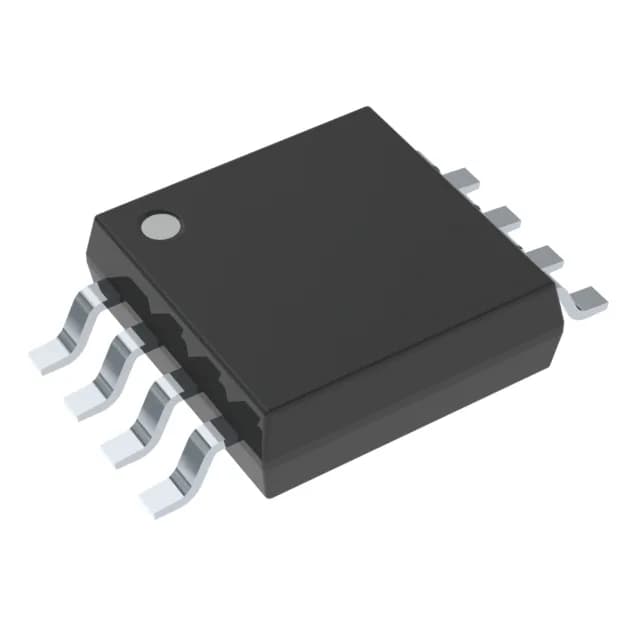
Dual 8-bit DAC in a small footprint — what it is and where it fits
The Maxim Integrated MAX550ACUA+ is a dual 8-bit, voltage-output digital-to-analog converter built around an R-2R ladder architecture. It communicates over an SPI interface and delivers an unbuffered voltage output, settling to within 1 LSB in 4 µs typical. The part operates from a single 2.5V to 5.5V supply — analog and digital share the same rail — making it a natural fit for battery-powered or 3.3V/5V systems where board space is tight. Housed in an 8-lead uMAX/uSOP package, it targets applications like programmable voltage references, digital trim pots, and low-speed closed-loop control in industrial or instrumentation settings.
Supply range and logic compatibility — one rail to rule them
Both the analog and digital supply pins share a common 2.5V to 5.5V range. That means a single 3.3V or 5V rail powers the entire DAC, and the SPI input thresholds track that rail. If your logic runs at 3.3V, the MAX550ACUA+ works directly — no level shifters needed. The 0°C to 70°C operating temperature covers commercial and most indoor industrial environments, but not extended or automotive ranges.
Settling time and linearity — what the numbers mean for your calibration budget
The 4 µs typical settling time sets the maximum update rate at roughly 250 kSPS for a full-scale step, though the unbuffered output means the load impedance directly affects the RC time constant. The integral nonlinearity is specified at ±0.9 LSB maximum — not a precision-grade converter, but adequate for 8-bit control loops and trim applications where the reference is external and can be chosen for drift performance. If you need better than 1 LSB absolute accuracy, budget for a calibration step at the system level.
Package and handling — uMAX footprint notes
The 8-uMAX/uSOP package (3.00 mm body width) is a common footprint shared with many Maxim small-outline parts. No moisture sensitivity level is stated, but standard MSL 1 handling is typical for this package family — still, bake before reflow if the bag seal is broken and the floor-life window is uncertain.
Lifecycle and compliance — active and RoHS3
It is RoHS3 compliant, so it passes the material restrictions for EU and most global markets. For new designs, this part is a safe choice without obsolescence risk in the near term.