16-bit R-2R DAC — output impedance and the buffer decision
The MAX5442ACUB+ is a 16-bit voltage-unbuffered DAC using an R-2R ladder architecture (cite:,). The output impedance is set by the ladder resistance, typically 10 kOhm — so any load below that will pull the output voltage off by the voltage-divider ratio. A buffer op-amp on the output is standard practice unless the load is a high-impedance input like a comparator or ADC reference. Settling time is 1 µs typical (cite:), which means the DAC can update at 1 MSPS — fast enough for audio-band waveform generation, servo setpoints, or automated test equipment channel updates. The SPI interface (cite:) is a three-wire bus that daisy-chains cleanly across multiple DACs on the same board.
Package and rework — 10-uMAX on the bench
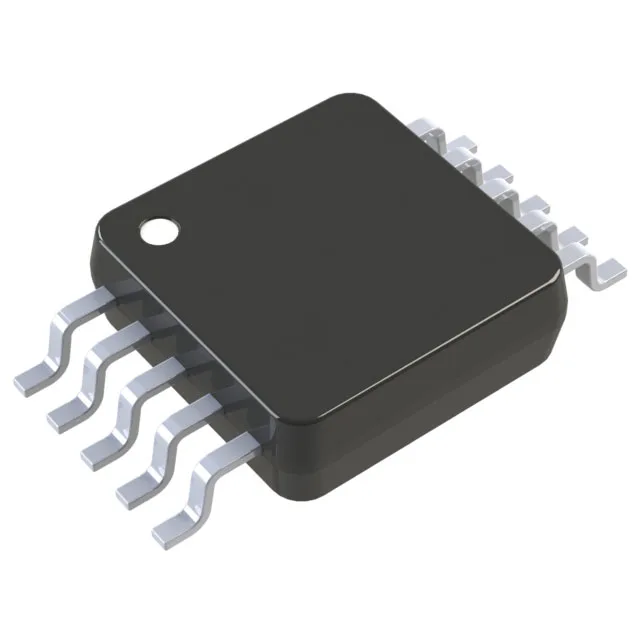
The 10-uMAX/uSOP package (cite:,) is a 3 mm × 3 mm body with 0.5 mm lead pitch — it reworks cleanly under hot air without a preheater. The leads are visible on all four sides, so alignment is straightforward. The part runs on a single 5 V supply for both analog and digital rails (cite:,) — no separate AVDD/DVDD split, which simplifies the board power routing. The external reference input (cite:) means the output full-scale voltage equals whatever reference you feed it; reference noise and drift multiply directly into the DAC output, so a clean reference is essential.