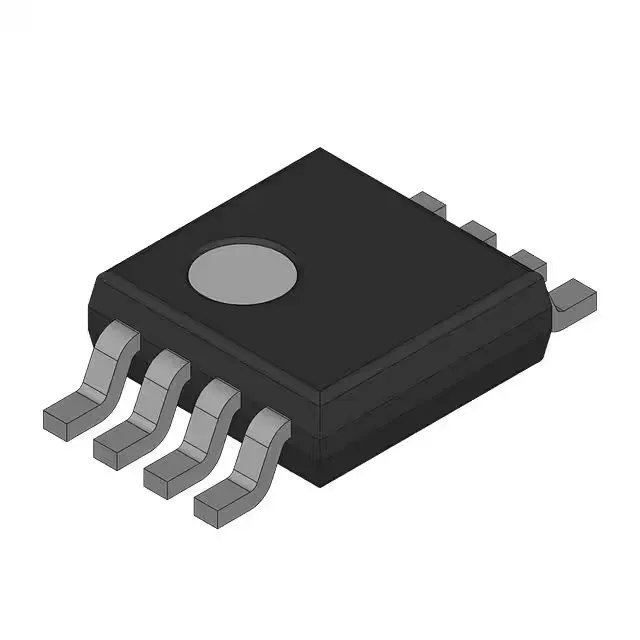
4-tap digital pot with a parallel interface — a coarse, fast trimmer
The MAX5431AEUB+ is a single-channel digital potentiometer with 4 taps and a linear taper, meaning the resistance between the wiper and either end changes in equal steps across the 57 kΩ total element. With only four positions, this is a coarse adjustment part — think gain select or mode trim, not a precision voltage divider. The parallel interface sets the wiper position directly without a serial clock, so a few GPIO lines from a microcontroller or a DIP switch can control it. No protocol overhead, no shift-register delay — the wiper moves on the same bus cycle the data is written. Memory is volatile: the wiper resets to its default position (typically mid-scale) every time the supply is cycled. If the application needs to remember a calibration value across power-off, an external EEPROM or a non-volatile digital pot is required.
Runs from a single 12 V to 15 V rail or from dual ±12 V to ±15 V supplies. The dual-supply option lets the wiper swing through ground, which is useful when the pot is used as a voltage divider in a bipolar signal chain — for example, trimming an op-amp offset that can be positive or negative. The 10-uMAX/uSOP package (3.00 mm × 3.00 mm body) is a compact surface-mount footprint that suits dense PCB layouts. Wiper resistance is 14 Ω typical — a small but non-zero series resistance that adds to the divider ratio. In a high-impedance load, the effect is negligible; in a low-impedance divider (e.g., setting a reference voltage for a 1 kΩ load), the 14 Ω wiper contributes a few percent of error.
Active production, ROHS3, and sourcing posture
ROHS3 compliant (no lead, no restricted substances beyond the standard exemptions), which means it ships into EU, UK, and global markets without a RoHS waiver.