8-bit octal DAC with SPI — what the specs mean for your analog output chain
The MAX5258EEE+ is an 8-bit, 8-channel voltage-output DAC from Analog Devices, built on a string-DAC architecture with an SPI data interface. It delivers a buffered voltage output per channel, settling to within 1 LSB in 10 µs typical — fast enough for real-time setpoint updates in multi-loop control without a per-channel sample-and-hold. Each of the eight converters shares a single external voltage reference (Reference Type: External), so the full-scale range is set by the reference voltage you supply — not by the DAC itself. This keeps the output span flexible across different sensor or actuator voltage domains.
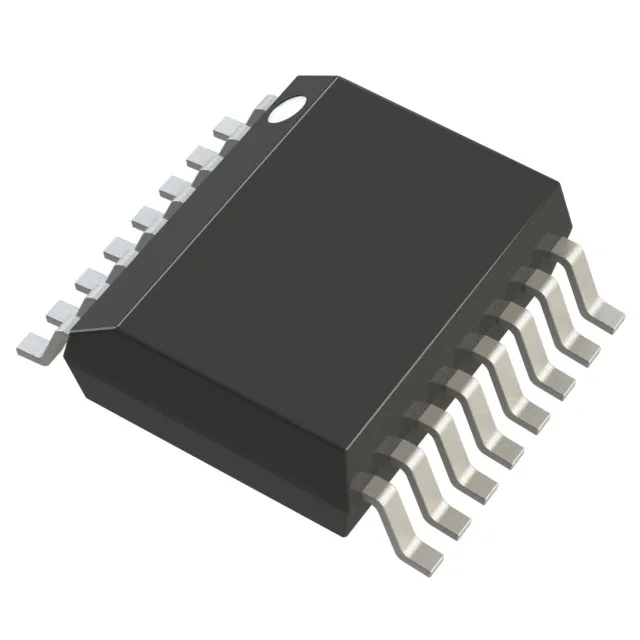
Package and rework reality — 16-pin SSOP/QSOP
Surface-mount only, delivered in a tube. The 0.025-inch pitch demands a fine-tip iron or a hot-air station with a small nozzle; a standard chisel tip bridges adjacent pins easily.
Linearity and monotonicity — why ±0.1 LSB INL matters
The integral non-linearity (INL) is ±0.1 LSB and the differential non-linearity (DNL) is ±0.05 LSB — both typical values. This means the DAC is guaranteed monotonic: every increase in digital code produces an increase (or at least no decrease) in analog output, which is essential for closed-loop control where a non-monotonic step could cause oscillation or a reverse-acting correction. With 8-bit resolution (256 steps), a ±0.1 LSB INL error corresponds to roughly ±0.04% of full scale — well within the tolerance of most industrial setpoint applications. The low DNL also means the step size is uniform across the range, so the output does not jump unevenly near mid-scale.
Supply rails and temperature range
Both the analog and digital supply rails are 5 V nominal (Voltage - Supply, Analog: 5V; Voltage - Supply, Digital: 5V). No separate AVDD/DVDD split — one clean 5 V rail powers the whole device. This part is safe to specify into a production BOM without immediate obsolescence risk.