Dual 12-bit DAC for precision analog output
The MAX5231BEEE+ integrates two 12-bit digital-to-analog converters with buffered voltage outputs on a single die, communicating over an SPI bus. The two converters share an internal reference and a common 5 V supply rail, so the BOM fit question is whether the system needs two independent analog outputs on one IC — this part delivers that without an external reference IC.
Linearity and settling — the accuracy budget
±1 LSB max INL and DNL across the 12-bit range sets the linearity floor — the DAC's output code will not deviate from the ideal transfer function by more than one LSB at any code, and no missing codes are guaranteed. For a 0-to-5 V output span, one LSB is 1.22 mV, so the system sees a maximum absolute error of about 1.22 mV from linearity alone. The 10 µs typical settling time to ±0.5 LSB defines the update rate ceiling. Driving a 100 kHz update at 10 µs per conversion leaves no margin for the SPI command overhead — practical throughput lands closer to 50 kHz to 80 kHz depending on the microcontroller's SPI clock speed and the number of command bytes per update. R-2R architecture delivers the 12-bit resolution without the glitch energy of a string-DAC topology. The internal reference eliminates the need for an external voltage reference IC, saving board area and one BOM line, but the reference accuracy is set by the on-chip bandgap — if the system requires a tighter absolute voltage tolerance than the internal reference provides, an external reference can override it via the REF input pin.
Package and board integration
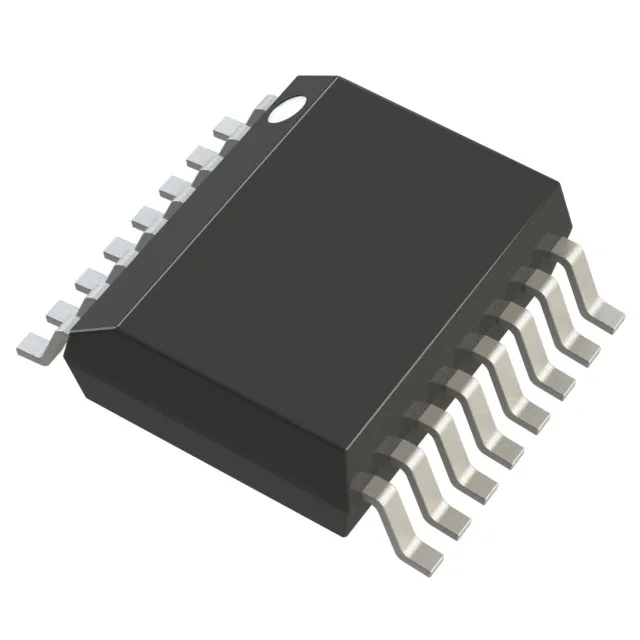
The 16-SSOP (0.154-inch, 3.90 mm width) and the supplier package 16-QSOP are near-identical footprints — the QSOP has a narrower body (3.90 mm vs the typical 5.30 mm of a standard SSOP), so the PCB land pattern must match the exact supplier package variant listed on the BOM. Surface-mount assembly with a 0.025-inch (0.635 mm) lead pitch; the tube packaging means the pick-and-place feeder setup uses a tube feeder rather than a tape reel. ROHS3 compliant — no exemptions that complicate EU or California market entry.