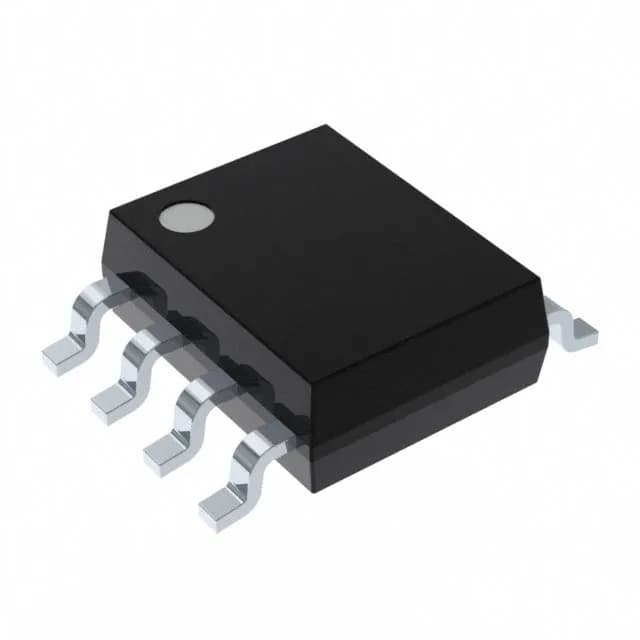
What this 10-bit DAC brings to the BOM
The Maxim Integrated MAX515CSA+T is a single-channel, 10-bit digital-to-analog converter with a voltage-buffered output and an R-2R ladder architecture. It communicates over a standard SPI interface, making it a straightforward drop-in for any microcontroller or FPGA that has a spare SPI port. The 25 µs typical settling time means it can update at roughly 40 kHz without losing accuracy, which suits slow control loops, trim potentiometer replacement, or programmable reference generation in test equipment. The part operates from a single 5 V supply for both analog and digital rails, simplifying power distribution. Its external reference input lets you set the output span independently of the supply, which is useful when you need a specific voltage range like 0–2.5 V or 0–4.096 V.
Linearity and monotonicity — the ±0.5 LSB guarantee
The MAX515CSA+T specifies integral nonlinearity (INL) and differential nonlinearity (DNL) at ±0.5 LSB maximum. That means every step from code 0 to 1023 is guaranteed monotonic — no missing codes, no non-monotonic jumps. For a calibration technician, this is the spec that matters: you can trust that each increment of the digital word produces a predictable analog step, and the overall transfer curve stays within half a least-significant bit of an ideal straight line.
Package and supply considerations for layout
Housed in an 8-pin SOIC (0.154" body width, 3.90 mm wide), the MAX515CSA+T is a surface-mount part that fits standard SOIC-8 footprints. The supply pins are both 5 V — analog and digital share the same rail — so a single 5 V regulator and a 0.1 µF decoupling capacitor close to each supply pin is the usual starting point. The external reference pin (REF) should be driven by a low-impedance source; a 10 µF tantalum in parallel with 0.1 µF ceramic at the reference input helps keep noise out of the conversion.
Temperature grade and environment
Rated for 0°C to 70°C operating temperature, this DAC is intended for commercial indoor environments — benchtop instruments, office equipment, consumer electronics, or lab gear. It is not specified for industrial or automotive temperature ranges, so if your design sees -40°C or +85°C ambient, look at the industrial-temperature variants in the MAX515 family.
Lifecycle and compliance
It is ROHS3 compliant, so it meets the latest EU hazardous-substance restrictions.