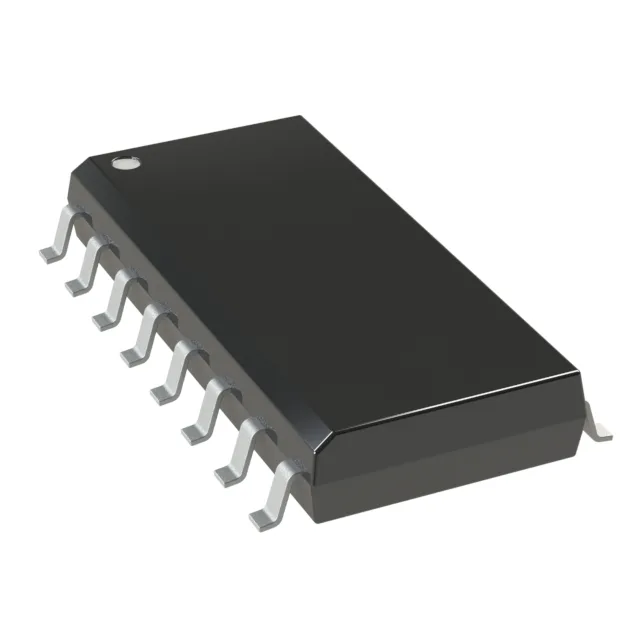
Dual 8-Bit DAC with 6µs settling — what it means for a control loop
The MAX5102AEUE+ packs two 8-bit voltage-output DACs with a 6µs typical settling time into a 16-TSSOP package. That settling time sets the update rate ceiling for a closed-loop system — at 6µs the converter can be updated at roughly 166 kHz, fast enough for most servo or bias-control loops that don't need the bandwidth of a dedicated 100+ Msps part. Both converters share a single external reference, so the two outputs track each other across temperature and supply shifts — useful when the DACs drive a push-pull or differential stage where channel matching matters more than absolute accuracy.
Supply rail and interface — single-supply simplicity
The parallel data interface means the output updates on a single write cycle with no serial clock overhead; the trade-off is more pins on the controller side, but for a 2-channel 8-bit part the 8 data lines are manageable. INL and DNL are both specified at ±1 LSB maximum — this is the monotonicity guarantee. For an 8-bit converter with 256 steps, ±1 LSB DNL means no missing codes across the full output range, which matters when the DAC sets a threshold or trim voltage where a skipped code would cause a step discontinuity.
Package and temperature — where this part fits on the board
Supplied in a tube (standard for small TSSOP quantities). ROHS3 compliant per the current Analog Devices manufacturing baseline — no exemption-based ROHS conflict to track.
Sourcing and compliance — active part, no end-of-life concern
No official second-source or pin-compatible replacement from another vendor is documented in the public record. For BOM risk mitigation, the 8-bit dual-DAC space has several parametric equivalents, but the pinout and footprint are unique to this ADI part.