Quad 8-bit DAC with SPI — what the ratings mean for your BOM
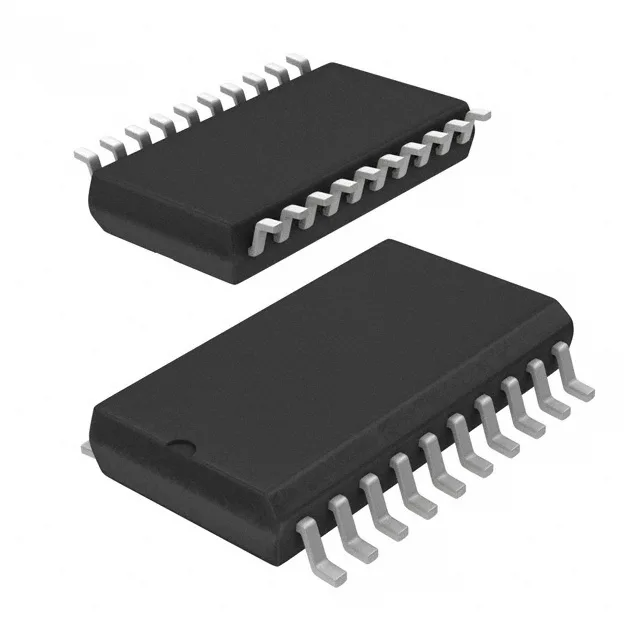
The MAX509BCWP+ is a quad 8-bit voltage-output digital-to-analog converter from Analog Devices, built on an R-2R ladder architecture. It packs four independent DAC channels into a 20-SOIC wide-body package, each with a buffered voltage output and a typical settling time of 6 µs — fast enough for closed-loop trim, set-point control, or waveform generation in industrial and instrumentation applications. The SPI data interface keeps the pin count low: four channels share a single serial bus, so a microcontroller with one SPI port can update all four outputs sequentially without extra GPIO. The external reference input (REF) lets you scale the output range independently of the supply rails — useful when the DAC must swing into a specific analog front-end window.
Supply rails and temperature grade — what they constrain
The analog supply is ±5 V (bipolar), while the digital supply is a single 5 V rail. This split means the output swing can go negative if the REF input is tied to a negative voltage — a common requirement for bipolar actuator drives or audio-level control. INL/DNL is specified as -, ±1 LSB (max). The missing INL figure is typical for this class — the monotonicity guarantee (no missing codes) is the practical spec to check. With ±1 LSB DNL, the DAC ensures every code step produces a unique output voltage, which matters for closed-loop systems where a non-monotonic step could cause oscillation.
Package, footprint, and handling for the reflow line
The tube delivery means the parts arrive aligned and static-dissipative; no tape-and-reel fee, but the tube adds a manual-pick step for high-volume lines unless you transfer to a feeder-compatible carrier. Surface-mount only — no through-hole variant exists in this series. The 20-SOIC wide-body has a 1.27 mm pitch, which is forgiving for hand-solder rework or automated optical inspection. If the reel history is unknown, a 24-hour bake at 125°C before reflow eliminates moisture risk.
For BOM planning, the SPI interface and quad-channel count are the pinout constraints — a drop-in replacement would need the same 20-SOIC footprint, same supply split, and same serial protocol. No such cross-reference is on file; any alternative would require a board spin or adapter.