Quad 8-bit DAC with I²C — what the key ratings mean for your BOM
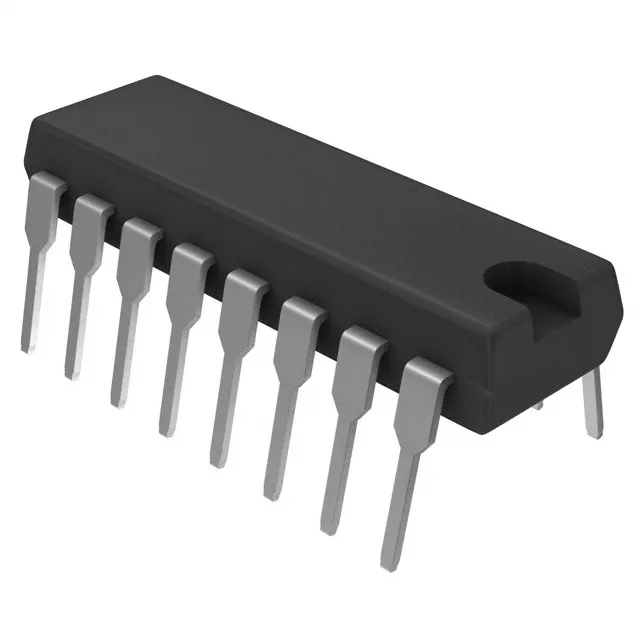
The MAX500ACPE+ is a quad 8-bit digital-to-analog converter from Analog Devices, packing four independent voltage-buffered outputs into a single 16-pin DIP package. It uses an R-2R ladder architecture and communicates over an I²C serial interface, making it a compact choice for multi-channel analog output in through-hole designs. With a settling time of 4.5 µs, each DAC channel reaches its final value within one half of a 108 kHz update cycle — fast enough for most closed-loop setpoint control or trim DAC applications, but not for waveform synthesis above audio rates. The ±0.5 LSB max INL and ±1 LSB max DNL guarantee monotonicity across the 8-bit range, so the output never steps backward as the digital code increases — critical for servo loops that can oscillate on a non-monotonic DAC.
Supply rails and temperature grade — what fits where
Both the analog and digital supply rails share the same 11.4 V to 16.5 V range, so a single 12 V or 15 V rail powers the entire part — no separate logic supply needed. The external reference input allows the full-scale output voltage to be set by an external voltage reference, decoupling the DAC's range from the supply tolerance.
Package and board-fit — through-hole, 0.300" DIP
Housed in a 16-pin PDIP (0.300" body width, 7.62 mm), the MAX500ACPE+ is a through-hole part supplied in a tube. It mates with standard 0.100" pitch DIP sockets or can be soldered directly into plated through-holes on a 2-layer PCB. The through-hole package simplifies hand-assembly and rework — no hot-air station needed — but the 16-pin DIP footprint is larger than a comparable SOIC, so board space is the trade-off.