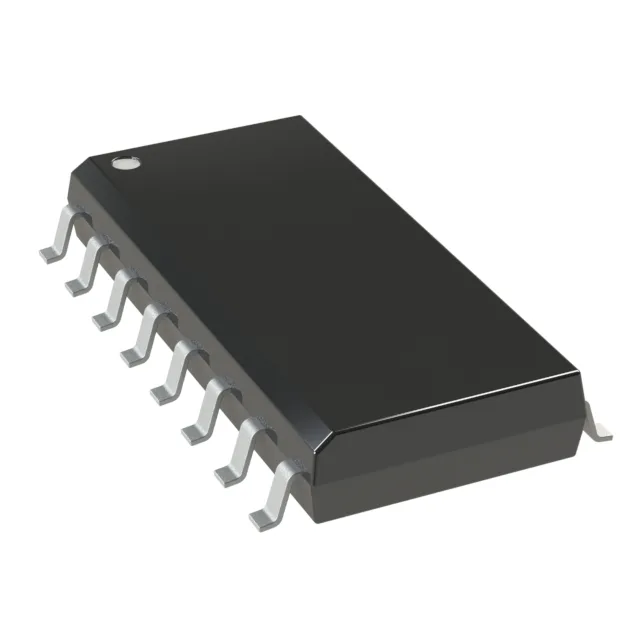
Dual SP4T switch with 1 Ohm flatness
The MAX4782EUE+ is a dual 4:1 multiplexer/demultiplexer (SP4T) analog switch from Analog Devices, built for routing low-voltage analog or digital signals through a common bus. Each of the two switch circuits connects one of four inputs to a common output, with the channel selected by a 2-bit address line. The headline spec is the 1 Ohm max on-resistance, with channel-to-channel matching held to 300 mOhm. That flatness matters when you are switching a precision reference or a sensor signal where the voltage drop across the switch must stay consistent from channel to channel — the matching figure tells you the worst-case delta between any two paths. Switching is fast enough for most data-acquisition and audio paths: 25 ns turn-on, 15 ns turn-off max. The -80 dB crosstalk at 1 MHz means a signal on one channel is attenuated by 10,000:1 before it leaks into an adjacent channel — clean enough for 10-bit or 12-bit multiplexed ADC front-ends.
Supply range and signal integrity
The switch handles signals from ground to V+, so the full supply swing is available as the analog signal range. Charge injection is rated at -110 pC typical. This is the charge dumped onto the signal line when the switch turns off; for a high-impedance node like a sample-and-hold capacitor, that 110 pC translates to a voltage glitch that settles within the switch's own turn-off time. Keep the downstream impedance low enough that the glitch decays before the ADC samples. Off-leakage current is 2 nA max per channel, and the off-capacitance on the common drain is 158 pF. That combination sets the bandwidth ceiling for the multiplexed bus — at 1 MHz the off-channel impedance is about 1 kOhm, which is fine for most audio and low-speed data paths but starts to load the signal at higher frequencies.
16-TSSOP package and handling
Housed in a 16-lead TSSOP with 0.65 mm pitch and 4.40 mm body width. Supplied in a tube (the standard shipping format for this order code). The tube protects the leads during handling; just be sure to orient pin 1 (the chamfered corner) before loading into the pick-and-place or hand-soldering. That covers most factory-floor and outdoor telecom enclosures without needing a mil-spec part.