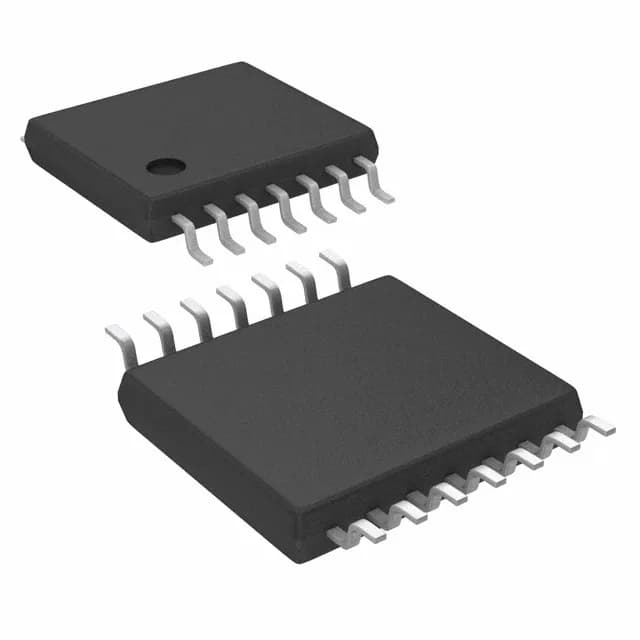
Four SPST-NO switches in a 14-TSSOP — what the ratings mean for signal routing
The MAX4737EUD+ from Maxim Integrated is a quad SPST-NO analog switch in a 14-TSSOP package, designed for routing analog or digital signals where low on-resistance and wide bandwidth matter. Each of the four switches is normally-open, with a 1:1 multiplexer/demultiplexer configuration, meaning each switch connects a single input to a single output when the control pin is asserted. The 4.5 ohm maximum on-resistance keeps signal attenuation low in the passband, and the 300 MHz -3dB bandwidth means this part can handle video, RF, or high-speed data paths without rolling off the signal. The 1.8V to 5.5V single-supply range lets it run from common logic rails (1.8V, 2.5V, 3.3V, 5V) without a separate negative supply, simplifying the power tree.
On-resistance flatness and channel matching — the signal-path budget
The 4.5 ohm max on-resistance is the headline number, but the channel-to-channel matching of 100 milliohm matters just as much in precision analog multiplexing. When switching between multiple sensor channels or gain stages, a 100 mOhm delta between channels keeps the gain error consistent across paths. The 5 pC charge injection spec tells you how much glitch gets dumped onto the signal when the switch turns on or off — important for sample-and-hold or DAC output multiplexing where a charge kick corrupts the settled value. Off-leakage is rated at 500 pA maximum, so high-impedance inputs won't see a significant current error.
Crosstalk and bandwidth — keeping channels isolated at speed
With -110 dB crosstalk at 1 MHz, the MAX4737EUD+ keeps signals from bleeding between channels in multi-channel audio, data acquisition, or RF switching applications. The 300 MHz bandwidth supports composite video, 100BASE-TX Ethernet analog front-ends, or IF signal routing. The 9 pF channel capacitance (both source and drain off-state) contributes to the bandwidth roll-off and also affects the settling time when driving a capacitive load — factor it into your RC time constant budget for the signal path.
Switching speed and timing margin
Turn-on time is 80 ns maximum, turn-off is 40 ns maximum. That asymmetry means the switch opens faster than it closes, which matters in break-before-make applications where you need to guarantee no momentary short between two signal sources. The 80 ns ton also sets the minimum pulse width you can reliably gate — at 12.5 MHz switching rate you start losing pulse integrity.
Package and footprint — 14-TSSOP layout notes
The 14-TSSOP package (4.40 mm body width, 0.65 mm pitch) is a common footprint shared with many analog switches and op-amps. The surface-mount package is suited for automated assembly. The operating temperature range of -40°C to +85°C covers industrial control, telecom infrastructure, and outdoor equipment without needing a mil-spec part.
Sourcing and lifecycle — active production, no LTB risk
It is ROHS3 compliant.