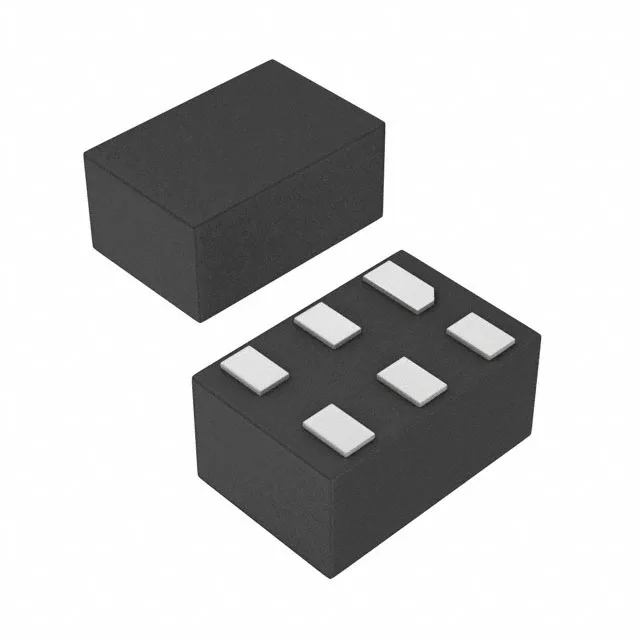
Active production, 300 MHz bandwidth, 5.5 Ohm Ron
The MAX4729ELT+T: The -3 dB bandwidth of 300 MHz makes it suitable for high-speed signal routing in video, RF, or data acquisition paths where the switch's insertion loss and flatness matter up to that frequency. Maximum on-resistance is 5.5 Ohm, with channel-to-channel matching of 50 mOhm — the matching figure tells you how closely the two switch legs track each other, which matters for gain accuracy in differential or matched-gain stages.
6-µDFN package and rework realities
That 1.5 mm x 1.0 mm footprint is small — the exposed pad underneath is the thermal path and the ground connection. Will it survive the hot air? Yes, but the pad needs a solid solder paste deposit and the board's thermal relief should be minimal to keep the pad temperature even during reflow. Surface mount only — no through-hole variant exists. The tape-and-reel or cut-tape packaging suits pick-and-place assembly; cut tape works for prototype or low-volume builds.
Switching speed, charge injection, and crosstalk
Maximum switch times are 45 ns turn-on and 26 ns turn-off. That 26 ns off time is the faster edge — the switch opens quicker than it closes, which is typical for CMOS analog switches and matters for break-before-make timing in multiplexed applications. Charge injection is 3 pC typical. In a sample-and-hold or integrator front-end, that 3 pC dumps onto the hold capacitor each time the switch opens, creating a voltage step equal to Q/C. For a 10 pF hold cap, that is a 300 mV glitch — budget for it in the settling time. Crosstalk is -67 dB at 1 MHz, meaning isolation between the two channels at that frequency is better than 2000:1. For audio or low-frequency analog multiplexing, this is clean; at 300 MHz the isolation will be lower, but the -3 dB bandwidth tells you the switch is still passing signal up there. Maximum off-leakage is 2 nA, and off-channel capacitance is 6.5 pF. The 2 nA leakage is negligible for most circuits; the 6.5 pF capacitance loads the source when the switch is off, which can matter for high-impedance sources above 100 kHz.