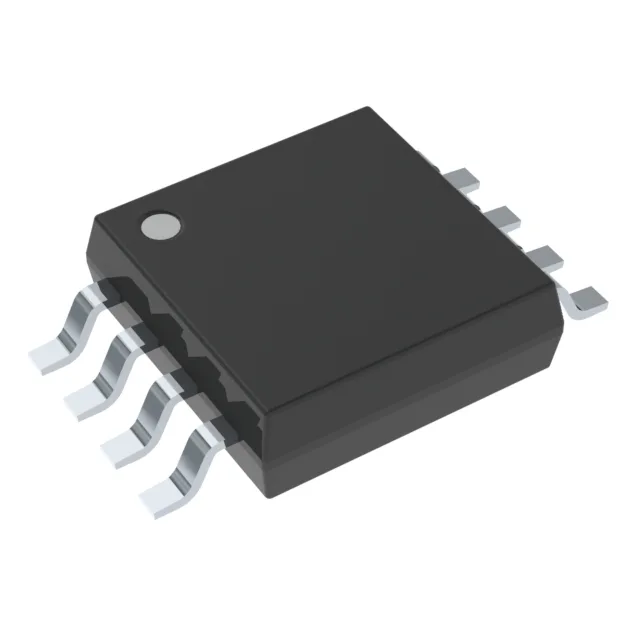
On-resistance and bandwidth define the signal path
The MAX4721EUA+T is a dual SPST-NO analog switch from Analog Devices, with a maximum on-resistance of 4.5 Ohm and a -3 dB bandwidth of 300 MHz. That combination means it can pass a high-frequency analog signal — up to video or RF — with minimal attenuation and without introducing a resistive voltage divider that would degrade the signal-to-noise ratio in a precision measurement chain.
Crosstalk and charge injection for multi-channel integrity
Crosstalk is specified at -110 dB at 1 MHz, which is the isolation between the two switch channels. In a multiplexed data-acquisition system where one channel is sampling while the other is settling, that figure keeps the feedthrough below the noise floor of a 16-bit ADC. Charge injection is 5 pC — a key parameter when the switch drives a sample-and-hold capacitor; the injected charge translates to a voltage step that must settle before the ADC conversion starts. Channel-to-channel on-resistance matching is 100 mOhm, which ensures that the gain error introduced by the switch is consistent across both paths. For a differential signal chain, this matching preserves the common-mode rejection ratio of the downstream amplifier. Switch timing is 80 ns turn-on and 40 ns turn-off maximum. That asymmetry is typical of CMOS switches — the turn-off edge is faster, which helps minimize the break-before-make gap in multiplexed applications. The 80 ns on-time sets the minimum channel dwell for a given sampling rate.
Supply range and leakage for low-power analog front ends
The switch operates from a single positive rail, so the analog signal must stay within the supply rails — it is not a true rail-to-rail switch, but the 4.5 Ohm on-resistance is flat across the signal range, which matters for linearity. Maximum off-leakage current is 500 pA at 25°C. For a sensor front end with a 10 MOhm source impedance, that leakage contributes a 5 µV offset error — negligible for most applications, but worth derating if the ambient temperature rises above 85°C, where leakage doubles every 10°C. Channel capacitance is 9 pF, which combines with the source impedance to form a low-pass filter; at 10 MOhm, the -3 dB point is about 1.8 kHz, so the switch itself does not limit bandwidth in high-impedance circuits.
The surface-mount package is suited for automated assembly; the Tape & Reel (TR) and Cut Tape (CT) options cover both production and prototyping quantities.