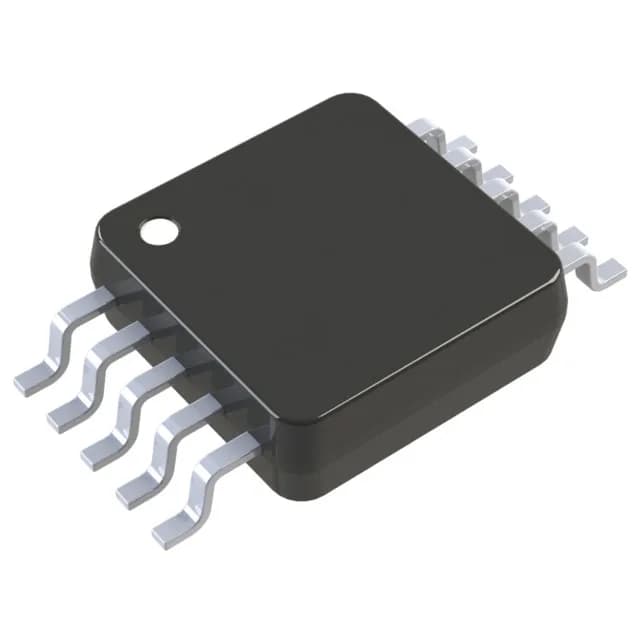
What is the MAX4719EUB+?
The MAX4719EUB+ is a dual SPDT analog switch from Analog Devices, meaning it contains two independent single-pole double-throw switches in one package — each switch routes a common pin to one of two outputs. It is built for multiplexing or signal routing in audio, data acquisition, and test equipment where signal integrity matters. Key parametrics: 20 Ohm max on-resistance, 300 MHz -3dB bandwidth, and -110 dB crosstalk at 1 MHz. The on-resistance stays flat across the 1.8V to 5.5V single supply range, which means the insertion loss does not shift much when the rail droops.
On-resistance and supply voltage range
On-resistance is 20 Ohm max — that is the resistance between the common pin and the selected output when the switch is on. For a 1V signal into a 10 kOhm load, the voltage drop across the switch is under 2 mV, negligible in most analog chains. Supply voltage runs from 1.8V to 5.5V single supply. The 1.8V floor means it works with modern low-voltage logic like 1.8V CMOS, while the 5.5V ceiling covers legacy 5V systems. No dual supply needed — one rail does it all.
Package, mounting, and temperature grade
Housed in a 10-uMAX/uSOP package (3.00 mm body width, 0.118-inch pitch), surface-mount only. The small footprint is good for dense boards, but the 0.50 mm pin pitch means a standard fine-tip iron works for hand rework — no hot-air station required if you have decent solder wick. The charge injection is 18 pC typical — low enough that glitch energy on switching stays under a few millivolts into a 10 pF load. Sourced per RFQ against your BOM quantity.
Switching speed and leakage
Turn-on time is 80 ns max, turn-off is 40 ns max. That 2:1 ratio means the switch opens faster than it closes — useful for break-before-make sequencing to prevent momentary shorting of two signal paths. Off-state leakage is 500 pA max at 25°C. In a high-impedance circuit like a pH probe or photodiode amplifier, that leakage is well below the sensor bias current, so it will not corrupt the measurement.