400 mOhm on-resistance and what it means for signal integrity
The MAX4716EXK+T: In a low-voltage signal path, that 400 mOhm series resistance drops about 4 mV at a 10 mA load current — negligible for most logic-level signals but worth budgeting if you're switching a precision reference or a sub-100 mV sensor output. The switch topology is a 1:1 multiplexer/demultiplexer in a normally-closed configuration, meaning the signal path conducts when the control pin is low and opens when driven high. That NC default is useful for fail-safe circuits where the signal must pass through until the controller actively disconnects it.
Switching speed and charge injection — bench limits
Turn-on time is 18 ns max, turn-off 12 ns max, so the switch can handle switching rates up to roughly 30 MHz before the timing budget gets tight. The 20 pC charge injection is typical for a low-Ron switch in this process — when the control pin toggles, that charge dumps into the signal path and can glitch a downstream sample-and-hold by several millivolts if the source impedance is high. Off-state leakage is 1 nA max, and the channel capacitance is 55 pF on both source and drain sides. That capacitance dominates the AC performance: into a 50-ohm load, the -3 dB bandwidth works out to about 58 MHz, so the switch is usable well into the HF band for small-signal routing.
Package and supply — board-fit constraints
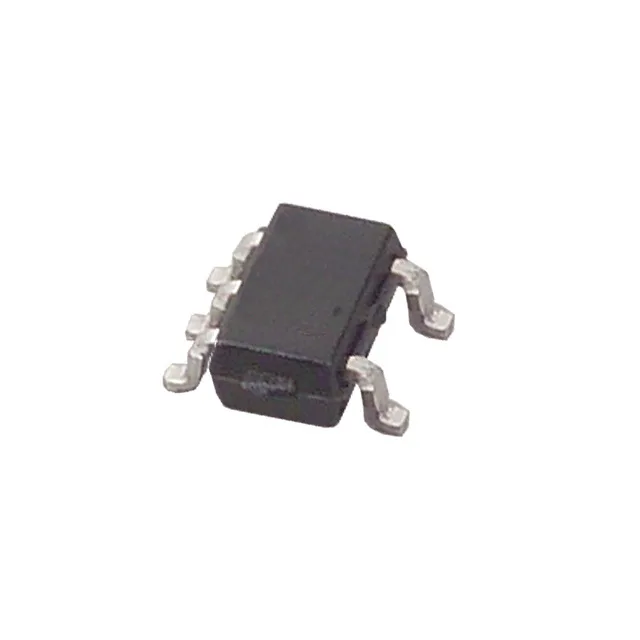
The SC-70-5 (SOT-353) package is a 5-pin surface-mount footprint about 2.0 mm × 2.1 mm. That covers most benchtop, telecom, and outdoor equipment but not extended automotive or downhole applications.
Lifecycle and sourcing for this BOM line
The part is ROHS3 compliant.