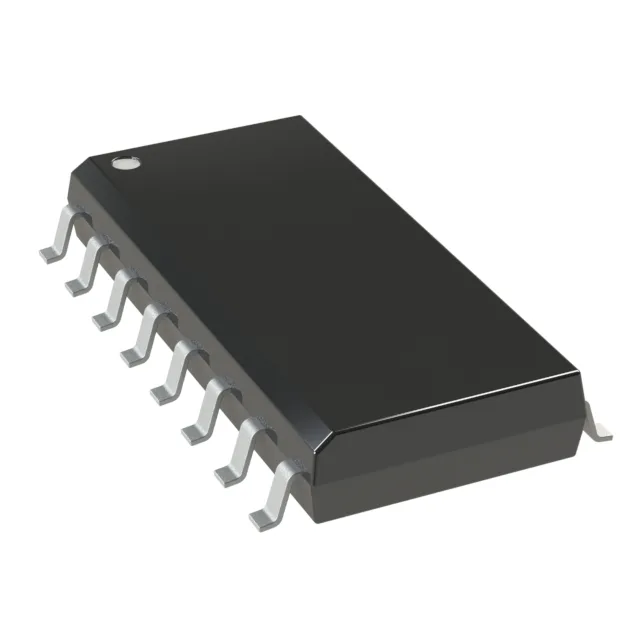
Quad SPST switch with low on-resistance for precision signal routing
The MAX4712EUE+T is a quad single-pole single-throw (SPST) normally-open analog switch from Analog Devices, configured as four independent 1:1 multiplexer/demultiplexer circuits. Each switch channel presents a maximum on-resistance of 25 Ohm with channel-to-channel matching held to 200 mOhm, which keeps the insertion loss uniform across all four paths in a multi-channel signal chain. The 125 ns turn-on and 80 ns turn-off times (max) allow the switch to keep up with fast multiplexing rates in data acquisition or audio routing.
Crosstalk and charge injection — what they mean for signal fidelity
Crosstalk is specified at -87 dB at 1 MHz, meaning that a 1 MHz signal on one channel couples into an adjacent channel at a level 87 dB below the carrier. For a 16-bit ADC system with a theoretical noise floor around -96 dBFS, this crosstalk floor sits below the converter's own quantization noise, so the switch does not limit the system's spurious-free dynamic range in most precision analog front-ends. Charge injection is 25 pC typical. When the switch opens, this charge packet dumps onto the sampling capacitor of a downstream sample-and-hold, producing a voltage error equal to 25 pC divided by the hold capacitance. For a 10 nF hold cap, the error is 2.5 mV; for a 100 pF cap it jumps to 250 mV — so the MAX4712EUE+T fits best where the hold capacitance is above 1 nF or where the injected charge can be settled out before the conversion starts. Off-leakage current is a maximum 500 pA at 25 °C, and the channel capacitance (both source and drain off) is 8 pF. These low parasitics mean the switch does not load the signal source when it is deselected, preserving the bandwidth of high-impedance sensor outputs or precision reference lines.
Industrial temperature grade and package for production
The operating temperature range spans -40 °C to +85 °C, covering the industrial ambient envelope. Supplied on Tape & Reel (also available in Cut Tape), the part is ready for automated pick-and-place. The reel quantity is the standard TSSOP-16 carrier, so it fits existing feeder setups without changeover.
Active lifecycle and compliance documentation
RoHS compliance documentation is available from the manufacturer. The part is free of the six restricted substances plus the four phthalates under EU RoHS 3 (2015/863), and it does not require an exemption certificate for standard lead-free soldering profiles.