Active production — BOM-fit for signal routing
The MAX4624EUT+T: The 1 Ohm max on-resistance keeps insertion loss low in audio, data-acquisition, and sensor-signal paths, while the 50 ns typical switching time supports multiplexing rates well into the low-MHz range.
On-resistance and matching — what they mean for signal integrity
Max on-resistance is 1 Ohm, with channel-to-channel matching of 60 mOhm typical. In a precision analog multiplexer, the matching figure matters more than the absolute Ron — it determines the gain-error spread between channels when the switch feeds a fixed-gain amplifier. Charge injection is 65 pC typical. In a sample-and-hold or integrator front-end, this injected charge appears as a voltage step across the hold capacitor — a 65 pC step into 10 nF gives a 6.5 mV glitch, which may need a track-and-hold settling cycle. Crosstalk is -57 dB at 1 MHz. For a 2:1 multiplexer switching between two analog channels, this isolation means the off-channel signal bleeds into the on-channel at about -57 dB below the passband — acceptable for 10-bit systems but marginal for 16-bit if the off-channel carries a full-scale signal.
Package, supply, and temperature — board-level integration
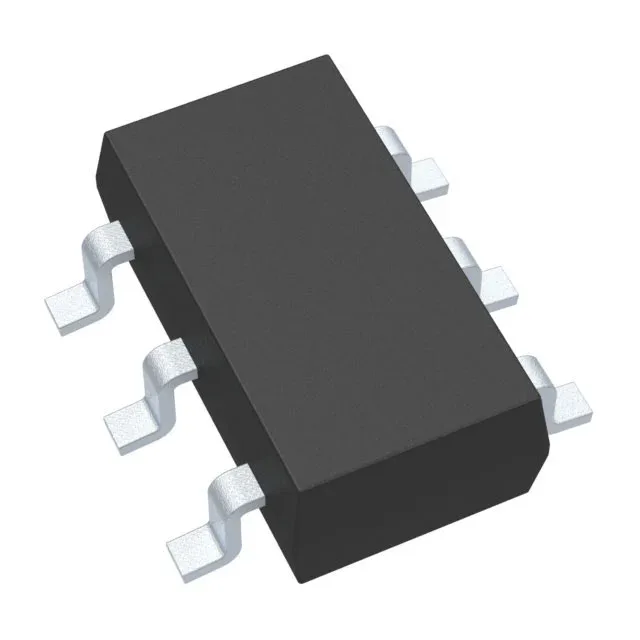
Housed in a 6-pin SOT-23 (SOT-6 supplier package), the part is surface-mount with a 0.95 mm pitch — a straightforward two-layer layout handles the signal and supply traces. Off-leakage current is 2 nA max at 25°C, rising with temperature but staying below 100 nA at 85°C — negligible for most signal paths.