What the 5 Ohm RON and 480pC charge injection mean on the bench
The MAX4622CSE+ is a dual DPST (1:1) analog switch — each of the two channels is a single-pole single-throw that either connects or disconnects the signal path, with no break-before-make action between outputs within a channel. On-resistance is 5 Ohm max across the full signal swing — low enough that in a 10 kOhm load the switch adds 0.05% gain error, but in a 600 Ohm audio line it drops 0.8% of the signal. The 250 mOhm channel-to-channel matching keeps differential paths balanced to within 0.25 Ohm, which matters for twisted-pair or stereo routing where the two legs must track. Charge injection of 480 pC is the glitch energy dumped onto the signal when the switch toggles. In a sample-and-hold front end driving a 100 pF cap, that injects a 4.8 V step — enough to saturate the following stage unless the downstream circuit settles. For DC-level switching or audio muting the glitch is usually benign, but watch it in precision acquisition chains. Crosstalk is -60 dB at 1 MHz — the isolation between the two channels at that frequency. For audio-band signals (20 Hz–20 kHz) the isolation is better, typically below -80 dB; for a 1 MHz data line the -60 dB figure means about 0.1% of the aggressor channel's signal couples into the quiet channel. That is fine for logic-level multiplexing but marginal for a 12-bit ADC front end switching at 1 MHz.
Supply rails and switching speed — what fits
The 34 pF channel capacitance on each side sets the -3 dB bandwidth to roughly 47 MHz into a 100 Ohm load — fine for video or high-speed serial up to a few MHz, but the bandwidth drops with higher source impedance. Switching times are 250 ns max for turn-on and 200 ns max for turn-off. That is fast enough for audio crossfading, relay-replacement in low-speed control loops, or multiplexing sensor channels at a few hundred kHz. The 500 pA max off-leakage means the switch introduces no measurable offset in a high-impedance node — a 10 MOhm source sees only 5 mV of voltage drop from leakage.
Package and temperature grade — commercial duty
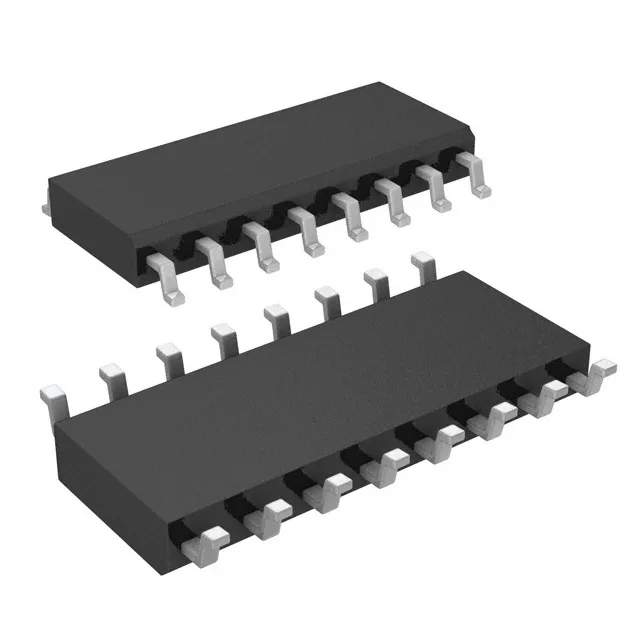
Housed in a 16-SOIC narrow-body (3.90 mm width), surface-mount, supplied in Tube format. The SOIC-16 footprint is standard — no fine-pitch rework needed.
RoHS3 compliant, so no lead or restricted-substance issue for EU or California markets. No official successor or second-source cross-reference is published; this part is the current production variant.