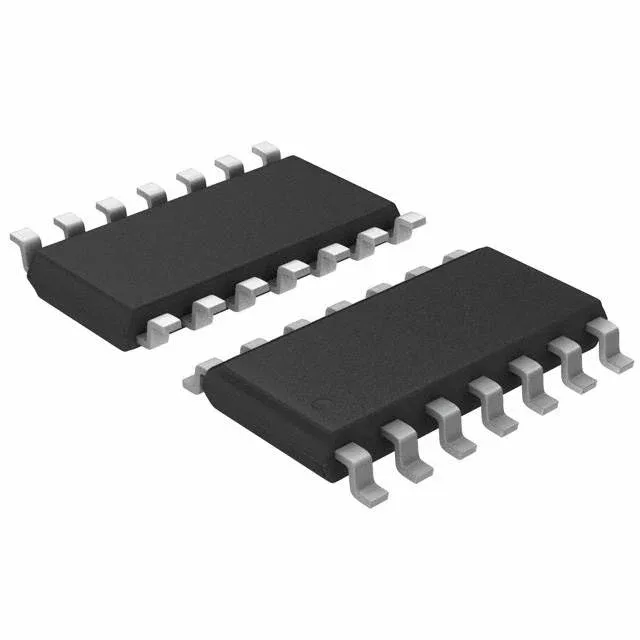
The MAX4616ESD+: The 1.27 mm pin pitch is standard for SOIC — no exotic footprint or via-in-pad required, and it reflows on a standard convection profile with a 183 °C solder peak for Sn63Pb37 or 260 °C for lead-free. Four independent SPST switches (each configurable as NO or NC) in one 14-pin package — a single IC replaces four discrete relays or FETs, saving board area and reducing parasitic capacitance. The industrial temperature grade (-40 °C to 85 °C) covers most factory-floor and outdoor equipment.
What the key ratings mean for the BOM
On-resistance is 10 Ohm max — low enough to pass a 0-5 V analog signal with less than 0.1 % voltage drop into a 10 kOhm load, and the 200 mOhm channel-to-channel matching keeps gain error consistent across all four paths. The -3 dB bandwidth of 70 MHz means the switch passes composite video (6 MHz) or 100BASE-TX Ethernet (31.25 MHz) without significant roll-off. Crosstalk is -96 dB at 100 kHz — adjacent channels won't bleed into each other in a precision multiplexer. Switching times are 12 ns (ton) and 10 ns (toff) — fast enough to multiplex 10 Msps analog signals or route digital control lines at 50 MHz. Charge injection is 6.5 pC, low enough that a 10 pF hold capacitor sees only a 0.65 mV glitch. Off-leakage is 1 nA max, and off-capacitance is 5 pF per channel — together they keep the signal path high-impedance when the switch is open, preserving the bandwidth of the driven line.
Analog Devices provides full datasheet documentation, including typical performance curves for on-resistance vs temperature and charge injection vs supply voltage — useful for worst-case analysis in a signal chain.