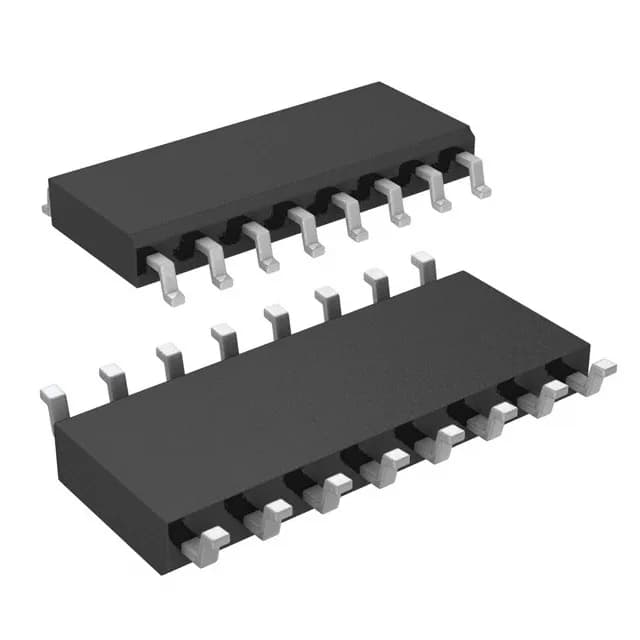
Four low-resistance SPST-NC switches in a 16-SOIC
The MAX4604CSE+ from Maxim Integrated packs four normally-closed SPST analog switches into a 16-SOIC package. Each switch presents a maximum on-resistance of 4 Ohms, with channel-to-channel matching held to 200 mOhms — tight enough that gain errors across channels stay within a fraction of a percent in precision analog paths. The 1:1 mux/demux topology means each switch is a single-pole pass gate, not a multiplexer; you route one signal per channel, on or off.
Supply rails and signal headroom
This part runs from a single supply between 4.5 V and 36 V, or from dual supplies spanning ±4.5 V to ±20 V. The wide range covers both single-rail battery systems and split-rail industrial analog front-ends. Switching times are 120 ns on, 130 ns off — fast enough for 1 MHz audio crosspoint or low-speed data acquisition muxing. Crosstalk between channels measures -60 dB at 1 MHz, which keeps channel bleed below the noise floor in 12-bit systems.
Charge injection and leakage — what to watch
Charge injection is specified at 225 pC. In a sample-and-hold or integrator front-end, that level of injected charge can cause a voltage step across the hold capacitor; budget for it in the acquisition chain. Off-leakage is a maximum 500 pA at 25 °C, so the switch holds its state well in high-impedance circuits. Each channel presents 34 pF of capacitance to ground when off — factor that into the RC settling time if you are switching into a high-source-impedance node.
Temperature grade and environment
Rated for commercial temperature range, 0 °C to 70 °C. That covers benchtop instrumentation, office equipment, and indoor industrial control panels. Not specified for automotive or extended industrial environments; if your application sees -40 °C or +85 °C ambient, look at the MAX4604's industrial-grade variant or a different switch family.
Lifecycle and sourcing
The MAX4604CSE+ carries an Active product status per the manufacturer, and it is ROHS3 compliant. No direct pin-compatible second source is listed in the available documentation, so dual-sourcing would require a board-level qualification of a functionally equivalent switch from another vendor.