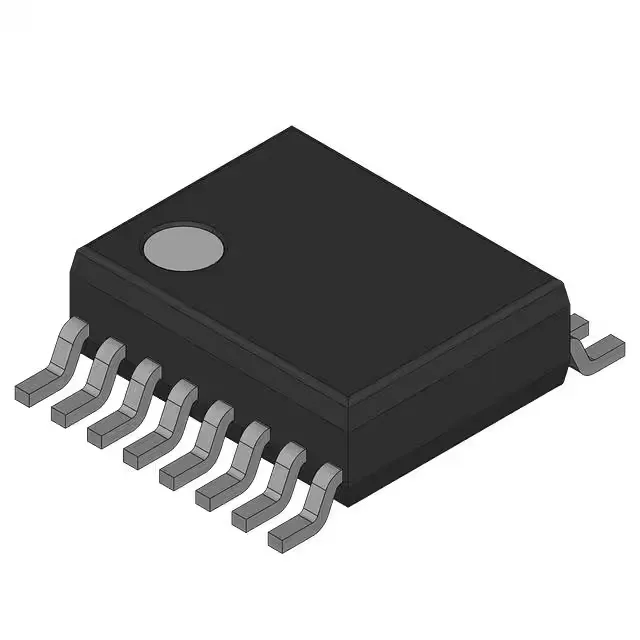
Three SPDT switches with 80 Ohm on-resistance and 1 Ohm matching
The MAX4583EEE+ integrates three independent SPDT (single-pole double-throw) switch circuits on one die, each configured as a 2:1 multiplexer or demultiplexer. Maximum on-resistance is 80 Ohm with channel-to-channel matching held to 1 Ohm — the low spread between the three paths means signal amplitude stays consistent when switching between channels, which matters in precision analog multiplexing where gain errors from varying Ron would otherwise accumulate. Supply flexibility covers both single-rail (2V to 12V) and dual-rail (±2V to ±6V) operation. On a ±5V analog supply the switch handles rail-to-rail signals; on a 3.3V digital bus it routes logic-level signals without a separate level translator.
Dynamic specs that govern signal fidelity
Crosstalk is specified at -73 dB at 1 MHz — less than 0.025% of a signal on one channel couples into an adjacent off-channel at that frequency. For audio-band multiplexing or moderate-speed analog routing this is clean enough to avoid bleed-through in most designs. Switching timing is asymmetric: 200 ns turn-on, 100 ns turn-off. The faster turn-off relative to turn-on creates a natural break-before-make window — useful when the switch feeds a sample-and-hold or an ADC input that must not see two sources momentarily shorted. Charge injection is 0.5 pC, leakage current 1 nA max, and off-capacitance is 4 pF (source) / 6 pF (drain) — these three together set the pedestal error and droop rate in switched-capacitor or track-and-hold circuits.
16-QSOP footprint for dense mixed-signal boards
QSOP is the tighter-body variant of SSOP — same pin pitch but narrower, saving board area in mixed-signal layouts where routing density is high. The part ships in tube format, surface-mount. RoHS3 compliant — no lead-in-solder exemptions, which means the part passes EU RoHS and similar restricted-substance regulations without special handling notes.