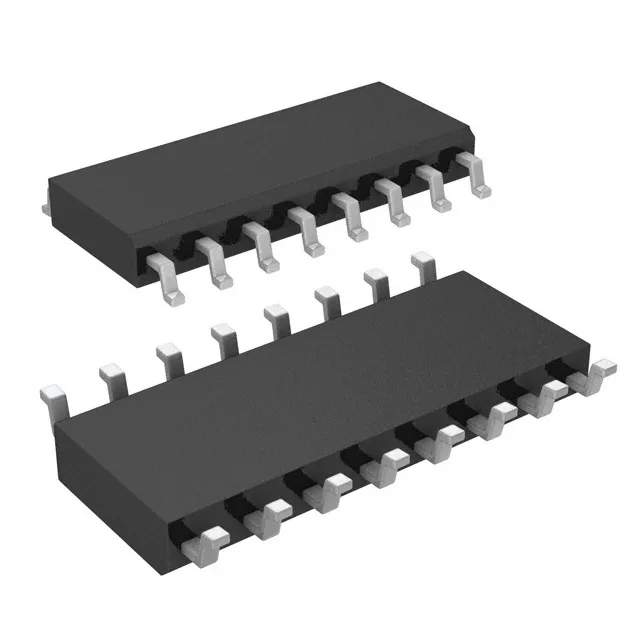
Triple SPDT in a 16-SOIC — three independent switches on one footprint
The MAX4583ASE+ packs three SPDT (single-pole double-throw) switches into a 16-pin SOIC package, each channel configurable as a 2:1 multiplexer or demultiplexer. With 80 ohm max on-resistance and 1 ohm channel-to-channel matching, it handles analog signals up to the supply rails without introducing gain errors between channels. Supply flexibility covers both single-rail (2 V to 12 V) and split-rail (±2 V to ±6 V) systems, so the same part fits a 5 V single-supply audio path or a ±5 V industrial analog front end.
Crosstalk and charge injection — what -73 dB and 0.5 pC mean for signal integrity
At 1 MHz, the crosstalk between channels is -73 dB — that is a 4470:1 rejection ratio. For a 1 V p-p signal on one channel, less than 0.22 mV leaks into the adjacent channel. This matters when multiplexing low-level sensor outputs or audio signals where bleed-through would corrupt the measurement. Charge injection of 0.5 pC means the switch injects a tiny charge packet into the signal path when turning off. For a 10 nF hold capacitor, that translates to a 50 µV glitch — negligible for 12-bit systems but worth budgeting in precision sample-and-hold or integrator reset circuits. Switching speed is 200 ns on, 100 ns off — fast enough for audio crossfades, gain-switching, and relay-replacement in control loops, but not designed for video or RF switching where sub-10 ns edges are required.
Active lifecycle — no end-of-line risk for production BOMs
Leakage current is 1 nA max across the full temperature range — the switch channel stays high-impedance when off, drawing negligible current from the signal source. Channel capacitance (4 pF off, 6 pF off at the common node) keeps the bandwidth above 10 MHz even with moderate source impedance.