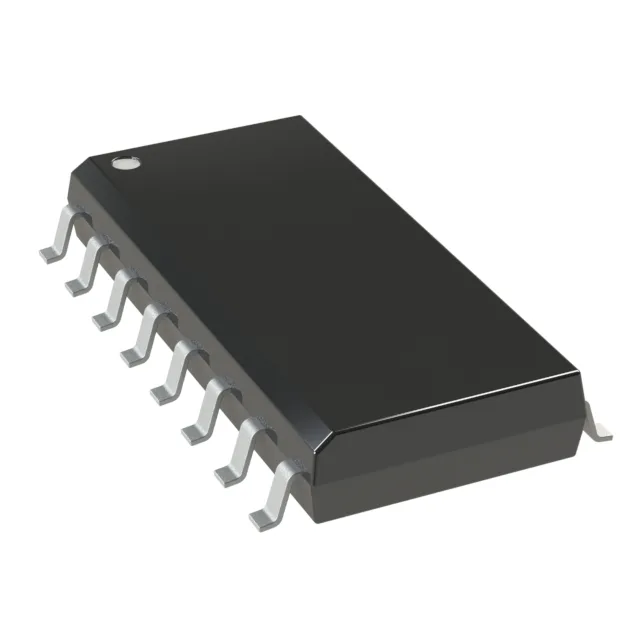
Dual SP4T analog multiplexer for signal routing
The MAX4582CUE+ is a CMOS analog multiplexer from Analog Devices containing two independent SP4T (single-pole, four-throw) switch circuits, each configured as a 4:1 multiplexer or demultiplexer. It routes one common I/O to any of four channels per section, giving eight total signal paths in a single 16-TSSOP package. On-resistance is 80 Ohm max, with channel-to-channel matching held to 1 Ohm. For an audio or instrumentation front-end, that matching keeps gain errors between channels below 1.25% when driving a fixed load impedance. Charge injection is rated 0.5 pC typical. In a sample-and-hold or data-acquisition path, that level of injected charge produces a voltage glitch of roughly 0.5 mV into a 1 nF hold capacitor — low enough to avoid significant settling errors in 12-bit systems. Crosstalk between channels is -96 dB at 1 MHz. For a 20 kHz audio bandwidth the isolation is even better, making this part suitable for multiplexing line-level audio signals without audible bleed-through.
Supply flexibility and switching performance
Operates from a single supply of 2 V to 12 V or dual supplies of ±2 V to ±6 V. The dual-supply option lets the switch handle bipolar analog signals up to the rail limits without level-shifting at the I/O pins. Switching times are 200 ns max turn-on and 100 ns max turn-off. At a 1 MHz multiplexer update rate, the on-time duty cycle exceeds 80% — fast enough for most data-acquisition and audio-routing applications. Off-channel leakage current is 1 nA max, and channel capacitance is 4 pF (off) / 10 pF (off common). The low leakage preserves DC accuracy in high-impedance sensor multiplexing; the capacitance sets a practical RC settling limit of roughly 800 ns into a 10 kOhm source.
Package, temperature grade, and compliance
Housed in a 16-pin TSSOP (4.40 mm width, 0.173" pitch) with a surface-mount footprint. The supplier device package is 16-TSSOP; the tube packaging suits prototype and low-volume assembly. Rated for commercial temperature range 0°C to 70°C ambient. This limits deployment to indoor, temperature-controlled equipment — not suitable for automotive or extended industrial environments without thermal margin analysis.