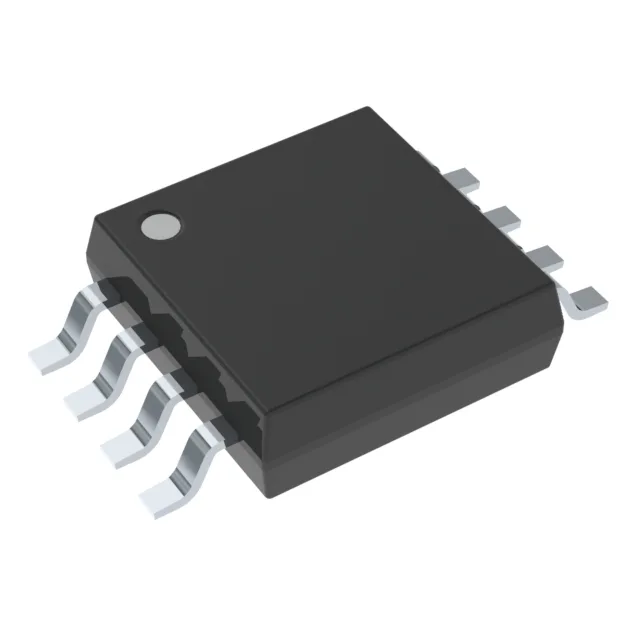
The MAX4564EUA+: On-resistance of 60 Ohm maximum sets the insertion loss floor for the signal path: at a 50 Ohm system impedance the switch adds about 0.5 dB of loss in the on-state, negligible for most baseband and video routes. Switching times of 60 ns turn-on and 40 ns turn-off maximum define the channel reconfiguration rate — the SPDT can toggle between sources at roughly 8 MHz without the output settling time dominating the timing budget. Leakage current of 1 nA maximum in the off-state means the switch does not load the signal node when deselected — critical for multiplexed ADC inputs where picoamp-level bias errors affect the conversion result.
Signal integrity ceiling — bandwidth and crosstalk
The 450 MHz -3 dB bandwidth supports composite video (NTSC/PAL at 6 MHz), baseband digital up to LVDS rates, and intermediate-frequency analog paths without roll-off at the passband edge. Crosstalk of -72 dB at 1 MHz means the off-channel signal bleeds into the active channel at roughly -72 dB relative to the carrier — this keeps adjacent-channel interference below the noise floor of a 12-bit ADC sampling at 1 MSPS. Charge injection of 3 pC is the charge dumped onto the load when the switch opens — for a 10 pF sampling capacitor this translates to a 300 mV glitch, which settles within the 60 ns turn-off window.
Package and board placement
Supplied in tube format (50 per tube typical for MSOP-8), the part suits manual assembly or low-volume reflow without reel-tape handling charges.
Compliance and regulatory acceptance
RoHS3 compliant (2015/863/EU) with no exemptions — the MAX4564EUA+ passes the 0.1 % substance limits for all ten restricted materials, including the four phthalates added in the 2015 amendment.