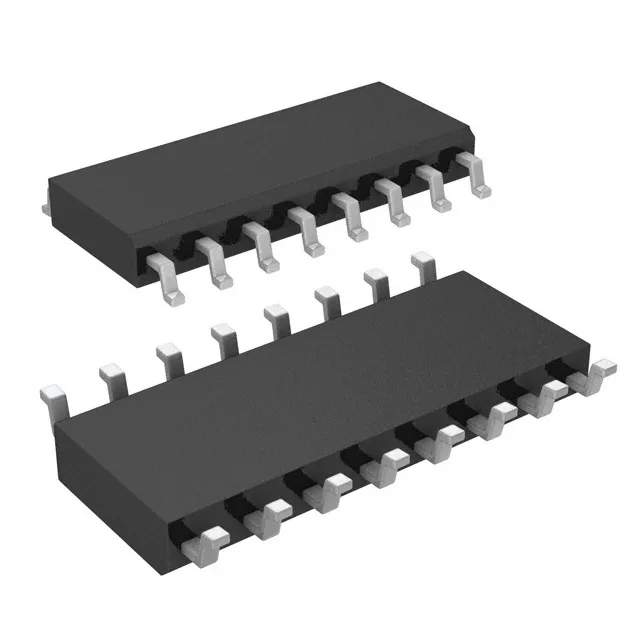
What the 120 Ohm on-resistance and 1 Ohm channel matching mean for your signal chain
The MAX4552ESE+ integrates four SPST normally-open switches in a 16-SOIC package, each with a max on-resistance of 120 Ohm. The 1 Ohm channel-to-channel matching means the insertion loss variation between any two signal paths stays under 1% for a 100 Ohm load — critical for maintaining gain flatness in a multi-channel analog front-end. Switch timing is 110 ns turn-on and 90 ns turn-off max, so the part can handle audio-frequency multiplexing up to several MHz without introducing noticeable glitch energy. The 2 pC charge injection keeps the DC offset transient below 2 mV into a 1 nF load — important when switching into a high-impedance ADC input. Crosstalk is rated -90 dB at 100 kHz, meaning a -10 dBm signal on an adjacent channel bleeds through at -100 dBm — well below the noise floor of a 16-bit ADC system. Off-leakage is 1 nA max, so the held voltage on a 10 nF sample cap drifts less than 0.1 mV over a 1 ms hold period. Channel capacitance is 3.5 pF on the source side and 3 pF on the drain side. This sets the bandwidth ceiling: into a 10 kOhm load, the -3 dB point is roughly 4.5 MHz, adequate for precision analog multiplexing up to video frequencies.
Supply voltage flexibility and single/dual rail options
The switch operates from a single supply of 2 V to 12 V, or from dual supplies of ±2 V to ±6 V. This covers common analog rails: 5 V single supply for a 0-5 V signal path, or ±5 V for a ±5 V bipolar signal swing.
The surface-mount package is compatible with reflow soldering; the tube packaging means the parts ship in anti-static tubes for manual or automated pick-and-place. Operating temperature range is -40°C to +85°C, covering industrial and commercial environments.