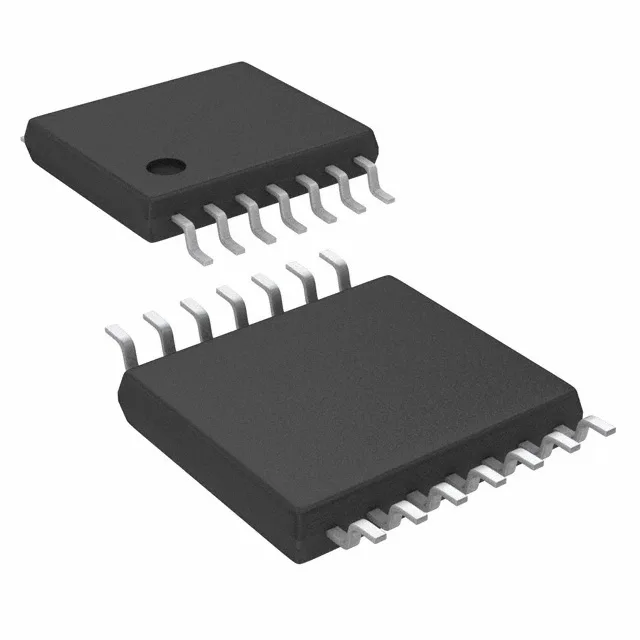
Signal routing in a 14-TSSOP footprint
The MAX4535EUD+ is a 2:1 multiplexer/demultiplexer with two independent DPST-NO switch circuits in a 14-TSSOP package. Each switch presents a maximum on-resistance of 400 ohms, with channel-to-channel matching held to 2 ohms — this keeps the insertion loss consistent across both paths in a differential signal chain. Crosstalk is specified at -53 dB at 1 MHz, which means the signal bleed from one channel into the other stays below 0.2% of the carrier amplitude at that frequency — relevant when multiplexing precision analog signals like sensor outputs or audio lines. Charge injection is rated at 1 pC typical — when the switch opens, the charge dumped onto the load capacitance is small enough that a downstream sample-and-hold or ADC input sees minimal voltage step for a 10 pF load.
Supply rails and temperature range
This dual-supply capability lets it pass bipolar signals without level-shifting — the switch handles signals that swing below ground when powered from ±5 V or ±15 V rails. Leakage current is a maximum of 500 pA in the off state — at 85°C this figure rises but stays in the low-nanoamp range, preserving the accuracy of high-impedance sensor front-ends connected to the switch output.
Switching speed and capacitance profile
Maximum turn-on time is 275 ns, turn-off time is 200 ns — this sets the multiplexing rate ceiling. For a system scanning two channels alternately, the minimum cycle time is 475 ns, giving a maximum switching frequency of about 2 MHz before the output settles incompletely. Channel capacitance is 5 pF on the source side and 4 pF on the drain side. Combined with the 400-ohm on-resistance, the -3 dB bandwidth into a 10 pF load is roughly 40 MHz — adequate for video or high-speed data acquisition up to that range.
Supplied in Tube packaging — 14-TSSOP tubes are standard for hand-assembly or low-volume pick-and-place. For reel packaging, check the tape-and-reel variant suffix; the Tube variant is the ordering code shown here.