Signal routing with 175 Ohm on-resistance and 1 Ohm channel matching
The MAX4533EWP+: Four independent SPDT switches, each configured as a 2:1 multiplexer/demultiplexer — the 175 Ohm max on-resistance is moderate for a ±18V-rated switch, but the 1 Ohm max channel-to-channel matching keeps gain errors uniform across all four paths in an analog multiplexing front-end. Switching time is 250 ns max (turn-on) and 150 ns max (turn-off) — fast enough for audio crosspoint switching, data acquisition channel scanning, and low-frequency signal routing. The -66 dB crosstalk at 1 MHz means adjacent channels bleed less than 0.05% into each other in a 1 Vpp signal, which is adequate for 12-bit systems. Charge injection is 1.5 pC typical — the glitch when switching a sample-and-hold capacitor is small enough to avoid significant hold-step error in a 16-bit SAR ADC front-end if the cap is under 100 pF.
Supply flexibility and leakage at temperature
Operates from a single 9V to 36V rail or dual ±4.5V to ±18V supplies — the dual-supply mode allows the switch to pass bipolar signals without a DC bias, which simplifies the analog front-end in industrial data acquisition where the signal swings below ground. Max off-leakage is 20 nA per channel — at 85°C the leakage doubles roughly every 10°C above 25°C, so budget around 320 nA worst-case. The 5 pF channel capacitance (source and drain off) sets the bandwidth roll-off when driving a high-impedance load; into a 10 kOhm load the -3 dB point is about 3.2 MHz.
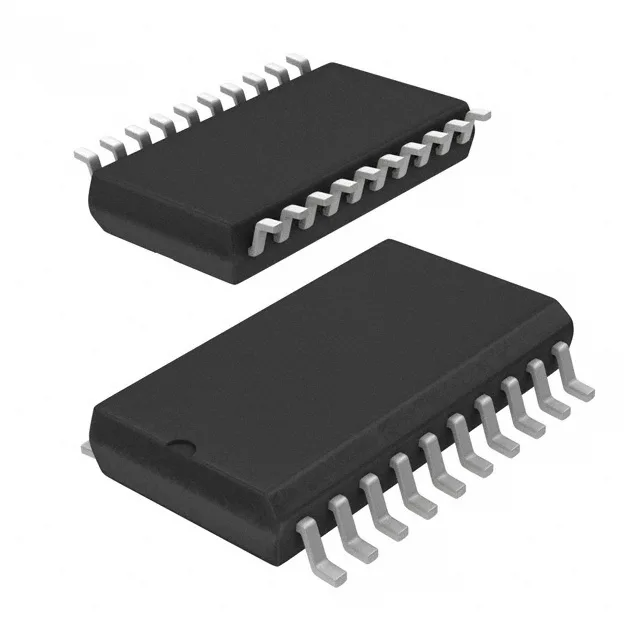
Supplied in a 20-SOIC wide-body (0.295-inch, 7.50 mm width) — the 1.27 mm pitch is hand-solderable and rework-friendly. The tube packaging is typical for engineering samples and low-volume production; for reel quantities confirm the tape-and-reel option with the supplier. Surface-mount assembly with standard reflow profile for JEDEC MSL-1 (if moisture sensitivity is not stated, assume standard bake-out). No exposed pad — thermal dissipation is through the leads; keep the copper pour under the body to aid heat spreading.