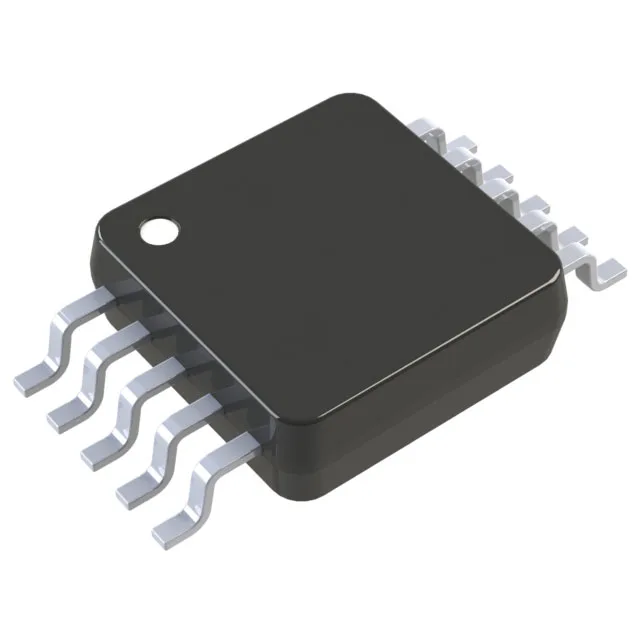
DPDT analog switch with 2:1 multiplexer topology
The MAX4525EUB+ is a single DPDT (Double-Pole Double-Throw) analog switch from Analog Devices, configured internally as a 2:1 multiplexer/demultiplexer per pole. It routes two independent signal pairs through one 10-pin package, which is useful for swapping audio channels, selecting feedback networks, or reconfiguring analog front-end paths without adding a second device.
On-resistance, matching, and switching speed
Maximum on-resistance is 150 Ohm, with channel-to-channel matching held to 2 Ohm. For a precision analog path — say a 10 kOhm source driving a 10 kOhm load — the 150 Ohm Ron adds roughly 1.5 % insertion loss, and the 2 Ohm mismatch between channels keeps the gain error between the two poles below 0.02 %. The 150 ns turn-on and 120 ns turn-off times (max) mean the switch settles before the next sample clock in most audio and low-speed data acquisition systems operating below a few hundred kHz. Charge injection is 0.8 pC typical — a 0.8 pC spike into a 10 pF sampling capacitor produces an 80 mV glitch, which matters if the downstream ADC samples immediately after switching. Leakage current is 1 nA max off-channel, negligible for a 10 MOhm input impedance front-end. Off-channel capacitance is 4 pF (source) and 6 pF (drain), setting the bandwidth ceiling: into a 50 Ohm load, the -3 dB roll-off from the 6 pF drain capacitance is around 530 MHz, well above the audio or low-frequency instrumentation band.
Crosstalk and signal isolation at 1 MHz
Crosstalk is specified at -74 dB at 1 MHz. This is the feedthrough from one closed channel to the other when both are active — at 1 MHz, a 1 Vpp signal on channel A leaks about 200 µVpp onto channel B. For a 16-bit ADC with a 2.5 V reference, the LSB is 38 µV, so the crosstalk floor sits roughly 5 LSBs below the full-scale signal; in a multiplexed data-acquisition system switching between sensors at 1 MHz, the adjacent-channel leakage is below the converter's noise floor.
The package is supplied in Tube, which is the standard through-hole-compatible carrier for prototyping and low-volume production. For reflow assembly, the 10-uMAX body has a 0.50 mm pitch — a standard 10-pin MSOP land pattern works.