What the switch circuit and on-resistance mean for your signal path
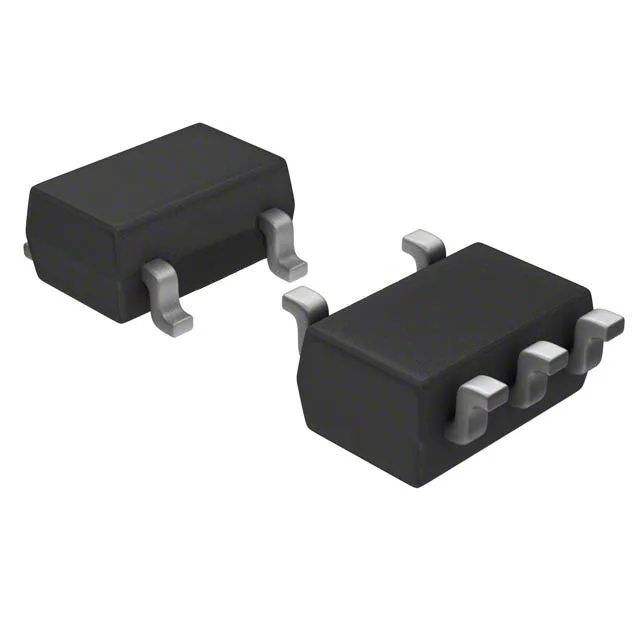
The MAX4515EUK+T is a single-pole single-throw normally-closed (SPST-NC) analog switch from Analog Devices, packaged in a 5-pin SOT-23-5. With a maximum on-resistance of 20 Ohms, it introduces a series resistance that matters for voltage-divider accuracy and signal attenuation in low-impedance paths — a 20 Ohm drop at 1 mA load is 20 mV, which is negligible for most logic-level signals but should be budgeted in precision analog chains.
Supply voltage range and switching performance
Operating from a single supply of 2V to 12V, the switch covers common rail voltages from 3.3V logic to 12V industrial supplies. The 150 ns turn-on and 100 ns turn-off times (max) keep the switch fast enough for audio muting, signal routing, or multiplexing below 3 MHz — the propagation delay is dominated by the RC time constant of the on-resistance and the load capacitance, not the switching time itself.
Charge injection and leakage — the analog purity specs
Charge injection is rated at 2 pC typical, a figure that determines how much glitch energy is dumped into the signal path during switching. For a 10 kOhm load, 2 pC produces roughly a 20 mV transient that settles within a few microseconds — acceptable for audio but worth a bench check in high-resolution ADC front-ends. Off-channel leakage is max 1 nA, which translates to a 10 µV error across a 10 kOhm source impedance — negligible for most applications.
The SOT-23-5 package (SC-74A) keeps the footprint small — 2.9 mm × 1.6 mm — and the surface-mount assembly is standard for automated pick-and-place.