Key ratings and what they mean for your board
The 400 ohm on-resistance is moderate — fine for driving high-impedance loads like op-amp inputs or ADC front-ends, but not for power switching or low-impedance audio outputs where you'd want single-digit ohms. The 275 ns turn-on and 200 ns turn-off times are fast enough for scanning sensor arrays or multiplexing signals at moderate rates, though not for high-speed video or RF switching. Crosstalk is rated at -62 dB at 1 MHz, which gives decent channel isolation for audio-band or low-frequency analog multiplexing; at higher frequencies it degrades, so keep that in mind for mixed-signal designs with fast edges nearby. Leakage current is a maximum of 500 pA off-state, and charge injection is 2 pC — both low enough that they won't disturb precision analog measurements in most data-acquisition or sample-and-hold circuits. The 10 pF / 14 pF channel capacitance (source off / drain off) is modest; it adds a small RC time constant with the source impedance, but for signals below a few hundred kHz it's rarely a concern.
Package and handling
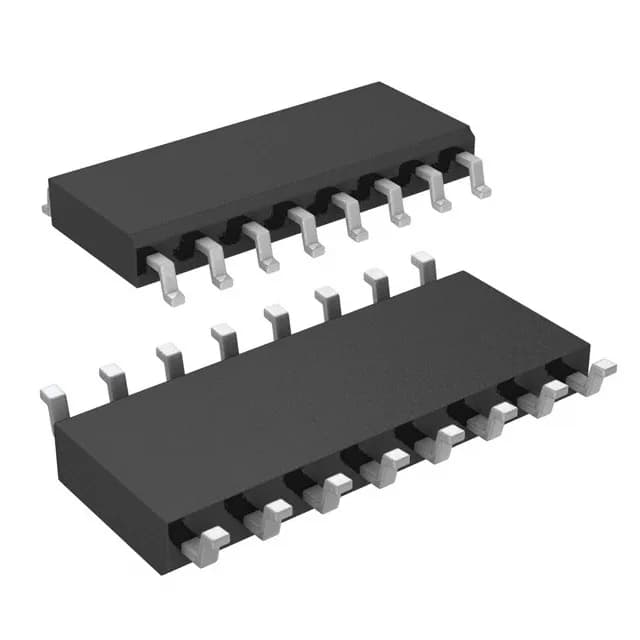
It comes in a 16-pin SOIC-8 body (0.154" wide, 3.90 mm width), surface-mount only. The '+' suffix on the order code indicates lead-free / ROHS3 compliant finish — no lead in the solder plating. It ships in a tube, not tape-and-reel, so if your pick-and-place line expects reels you'll need to transfer to tape or order the reel-pack variant. MSL is not listed in this data, but SOIC packages are typically MSL 1 or 2; still, bake before reflow if the moisture barrier bag has been open longer than the floor life.
Lifecycle and sourcing
It is ROHS3 compliant, so no restriction on use in new designs for RoHS-regulated markets. No official second source or pin-compatible alternate is listed in the record, so for dual-sourcing resilience you'd need to qualify a functionally similar part from another vendor on your own bench.