42 MHz GBW and 10V/µs slew rate — what they mean for signal bandwidth
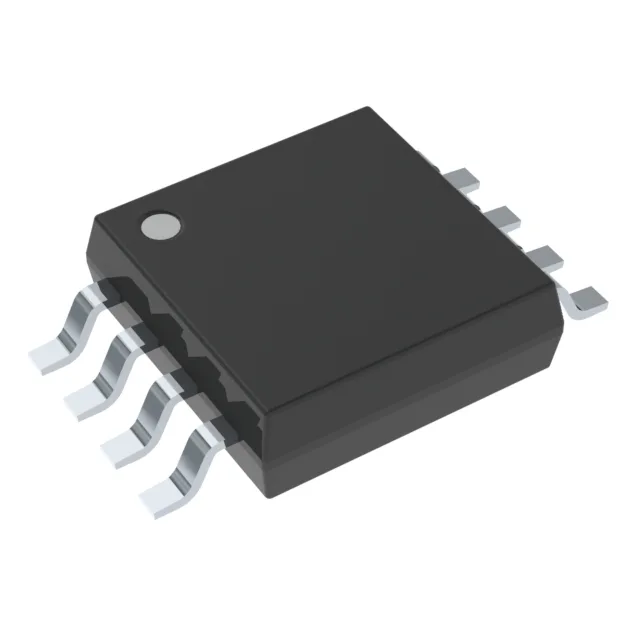
The MAX4489AUA+: The 42 MHz gain-bandwidth product sets the small-signal bandwidth ceiling: at a closed-loop gain of 10, the -3 dB point lands around 4.2 MHz. The 10V/µs slew rate governs the large-signal response — a 5 V output step slews in 500 ns, so the op-amp tracks fast edges without distortion up to about 3.2 MHz full-power bandwidth.
Input bias and offset — the precision side
The 70 µV input offset voltage is the DC error term to budget: at a gain of 100, that becomes 7 mV at the output, which matters for a 12-bit system with a 2.5 V reference (1 LSB ≈ 610 µV). Supply current is 2.5 mA per channel — 5 mA total for the dual package. That is moderate for a 42 MHz amplifier; the trade-off is that the output stage can deliver 48 mA per channel into a 50 Ω load without significant crossover distortion.
Temperature range and package — deployment reality
Rated -40°C to +125°C, this is an industrial-temperature part that lives in an engine bay, a solar inverter, or a factory-floor sensor head — not just a lab bench. The 8-uMAX/uSOP package is a 3 mm × 3 mm body with 0.65 mm pitch, so a standard two-layer board with 6/6 mil trace/space handles the fan-out.
Analog Devices lists the MAX4489AUA+ as Active and ROHS3 compliant.