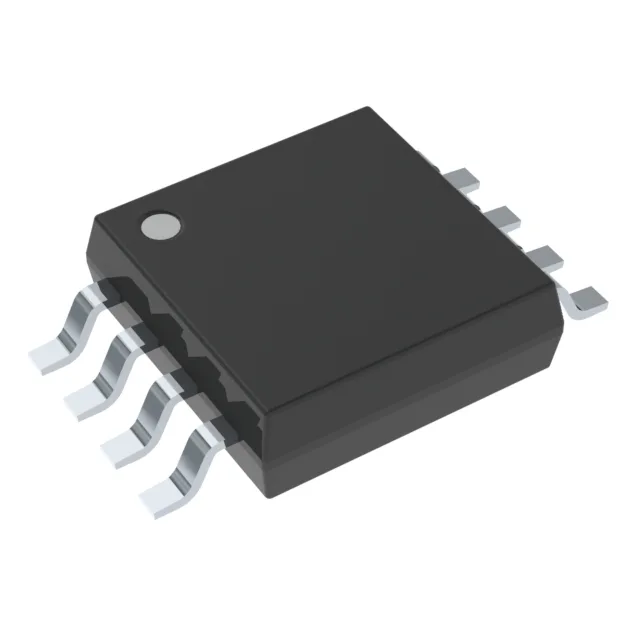
What the 10 MHz gain bandwidth and 3V/µs slew rate mean for signal chain design
The MAX4475AUA+T: For a unity-gain buffer, the small-signal bandwidth extends to 10 MHz; at a gain of 10, the closed-loop bandwidth drops to 1 MHz. The 3V/µs slew rate sets the large-signal limit — a 2 Vpp output step slews in about 670 ns, which keeps distortion low for audio-band signals but limits full-power bandwidth to roughly 240 kHz at 2 Vpp.
Rail-to-rail output and supply flexibility
Quiescent current is 2.5 mA per amplifier, so the thermal budget in the 8-uMAX/uSOP package stays manageable even at 125°C ambient.
Input characteristics and precision
Input bias current is 1 pA typical — a CMOS input stage that suits high-impedance sources like photodiode transimpedance stages or pH sensor front-ends. Input offset voltage is 70 µV typical; for a gain of 100, the DC error at the output is 7 mV before any trimming. The 48 mA output current per channel drives moderate loads directly, though heavy capacitive loads may need a small series resistor to maintain phase margin.
The supplier device package is 8-uMAX/uSOP — the same mechanical outline. Tape & Reel (TR) and Cut Tape (CT) options are available; the reel quantity suits automated pick-and-place, while cut tape works for prototype builds. Surface-mount reflow profile follows standard MSL 1 handling for this package class.