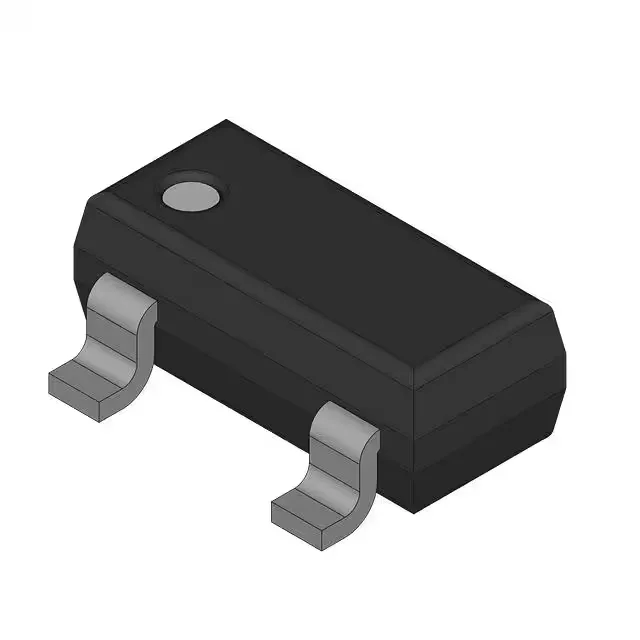
Instrumentation amp in a SOT-23-6 — what you get
The MAX4461TEUT: It delivers a gain-bandwidth product of 2.5 MHz and a -3 dB bandwidth of 250 kHz, with a 0.5V/µs slew rate. The rail-to-rail output stage and 1 pA input bias current make it a fit for high-impedance sensor conditioning — think bridge transducers, thermocouples, or photodiode front-ends where you need the input offset current to stay out of the measurement. The output can source or sink 150 mA, which is unusually muscular for an instrumentation amp — enough to drive a long cable or a small relay directly without a buffer.
Supply voltage and temperature — where it runs
The SOT-23-6 package limits dissipation; with the 800 µA quiescent supply and moderate output current, thermal rise is manageable in still air, but check the junction temperature if you plan to push the 150 mA output continuously at the high end of the temperature range.
Active lifecycle, but watch the RoHS flag
The catch: it is listed as RoHS non-compliant. If your BOM requires RoHS compliance (most commercial and consumer electronics do), this part will need an exemption or a waiver. For defence, aerospace, or high-reliability projects that still use leaded solder, the non-compliant status is actually the preferred option.
The 0.5V/µs slew rate sets the large-signal response. For a 5 V output swing, the amplifier takes about 10 µs to slew — fine for audio-frequency signals and slow sensor outputs, but not for fast pulse trains or high-frequency AC measurements. The 250 kHz -3 dB bandwidth defines the small-signal passband; beyond that, gain rolls off. With a gain-bandwidth product of 2.5 MHz, you trade gain for bandwidth: at a gain of 100, expect a usable bandwidth around 25 kHz. That is typical for an instrumentation amp — the architecture prioritises precision and CMRR over speed.