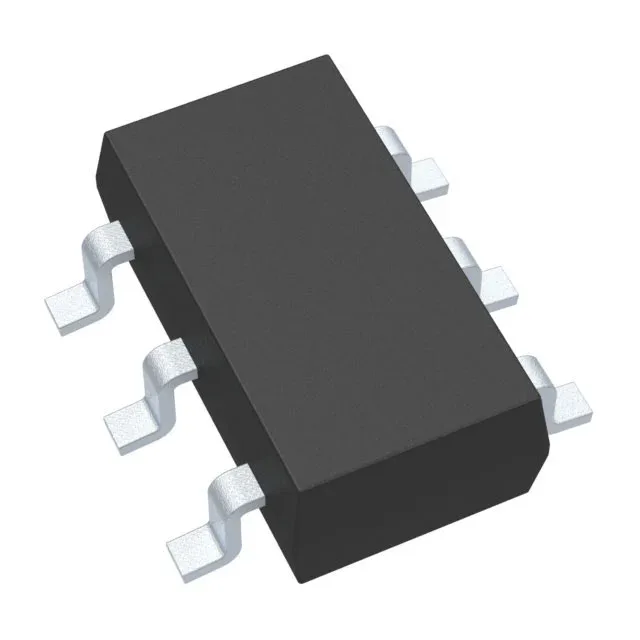
Package and board-fit for a low-side shunt
The MAX44284WAUT+T comes in a SOT-23-6 (SOT-6) package — six leads on a 0.95 mm pitch, body roughly 2.9 mm × 1.6 mm. That footprint is small enough to tuck next to the shunt resistor on a tight layout, and the exposed pad on the underside (if present — check the mechanical drawing) helps pull heat into the board plane. Surface-mount only; no through-hole option. The 21 µA quiescent current means it's viable for loop-powered 4-20 mA transmitters or battery-monitoring circuits where every microamp counts.
This is a current-sense amplifier — it amplifies the small differential voltage across a shunt resistor and outputs a ground-referenced voltage proportional to the load current. The 10 µV typical input offset sets the floor for how small a shunt voltage you can resolve: with a 10 mΩ shunt, 10 µV corresponds to 1 mA of load current. Below that, offset dominates the reading. Input bias current is 2 nA typical — negligible compared to the shunt current in most power-monitoring applications, so it won't introduce a meaningful error across the shunt resistance. The 1 kHz bandwidth limits this part to DC and low-frequency current sensing; it won't capture switching ripple above a few hundred hertz. The -40°C to 125°C operating range covers industrial enclosures, engine bays, and outdoor telecom cabinets. The offset and bias drift with temperature, but the 10 µV baseline gives headroom before the error becomes significant at the hot end.