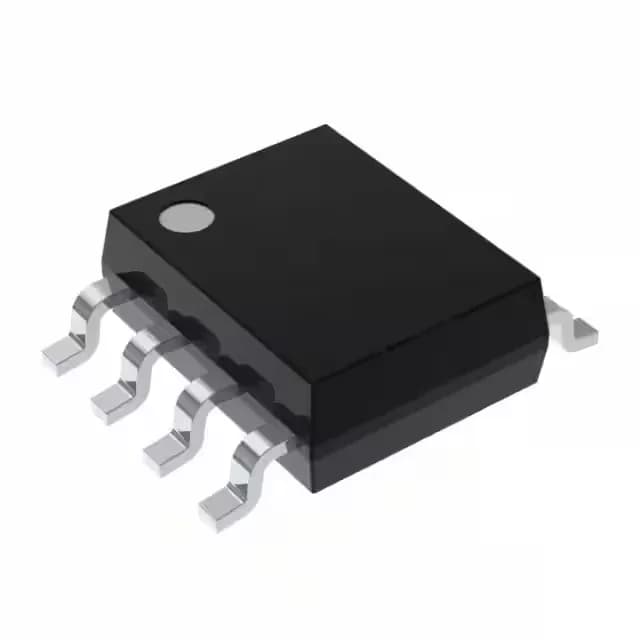
Precision zero-drift amplifier with 2 µV offset — what that buys the design
That offset stays stable over temperature and time because the auto-correction topology continuously nulls the input stage. For a bridge-type sensor (load cell, pressure transducer, strain gauge) or a thermocouple amplifier, this means you can resolve microvolt-level signals without a separate trimming step or a software calibration routine. The 90 µA supply current per channel keeps the total quiescent draw at 180 µA for both amplifiers, which is low enough for loop-powered 4-20 mA transmitters or battery-operated data loggers.
Supply range and output swing — one part for 3.3 V and ±15 V rails
The supply span runs from 2.7 V minimum to 36 V maximum, so the same device works on a 3.3 V single supply, a 5 V logic rail, or a ±15 V industrial bus. The rail-to-rail output stage swings within millivolts of each rail, preserving dynamic range at low supply voltages. With 40 mA output drive per channel, the amplifier can directly drive an ADC input, a small relay coil, or a 50 Ω transmission line in a test fixture. The 0.7 V/µs slew rate and 1 MHz gain-bandwidth product are modest — this is a precision DC part, not a video amplifier — but adequate for 10 kHz-class signals and anti-aliasing filters.