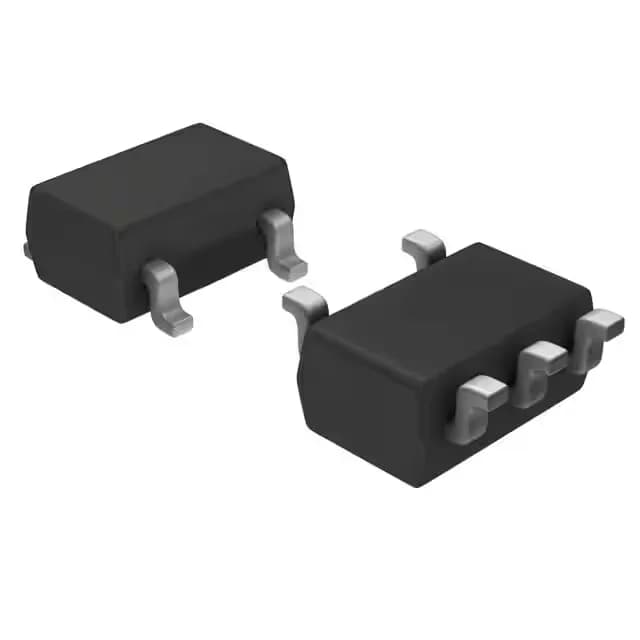
Single-supply precision op-amp in a SOT-23-5
It combines a 5 MHz gain-bandwidth product with an exceptionally low 1 µV input offset voltage, making it suitable for precision signal conditioning in space-constrained designs.
The 1 µV maximum input offset voltage is an order of magnitude better than typical general-purpose op-amps, which often spec 100 µV to 1 mV. This lets the MAX44241AUK+T resolve microvolt-level signals without a separate auto-zero or chopper-stabilized amplifier. For a 12-bit ADC with a 2.5 V reference, the offset contributes less than 0.2 LSB of error — negligible in most data-acquisition paths. The 300 pA input bias current keeps DC errors low even with high-impedance sources like photodiodes or pH probes.
5 MHz GBW and 3.8 V/µs slew rate — bandwidth budget
The 5 MHz gain-bandwidth product supports closed-loop gains up to 100 with a 50 kHz small-signal bandwidth, or unity-gain buffers up to 5 MHz. The 3.8 V/µs slew rate handles 2 Vpp output swings at frequencies up to roughly 300 kHz before slew limiting sets in — adequate for audio, sensor excitation, and motor-current sense amplifiers. The rail-to-rail output swings within 50 mV of each rail at light loads, preserving dynamic range in low-voltage systems.
Operating from 2.7 V to 36 V, this op-amp fits into 3.3 V battery-powered designs and 24 V industrial PLC analog input modules alike. The 40 mA output current per channel can directly drive a reference input, a small relay coil, or a 50 Ω back-terminated line. Supply current is 420 µA, keeping the thermal budget low in dense multi-channel boards.
Package and footprint — SOT-23-5
The MAX44241AUK+T is supplied in a SOT-23-5 package, also described as SC-74A. The five-pin footprint occupies roughly 3 mm × 3 mm, suitable for compact sensor modules and portable instruments. Cut Tape (CT) quantities are also available for prototyping.
Lifecycle and compliance
It is ROHS3 compliant, with no exemptions that would restrict its use in EU-market equipment.