What this op amp brings to the rail
The MAX4281EUK+T is a single-supply, general-purpose operational amplifier from Maxim Integrated's GainAmp™ series. It delivers a 2 MHz gain-bandwidth product and a 0.7 V/µs slew rate, sufficient for audio-band filtering, sensor buffering, and low-frequency signal conditioning in portable or industrial equipment. The rail-to-rail output stage maximizes dynamic range when operating from a single 2.5 V to 5.5 V supply rail — a common requirement in battery-powered or 3.3 V/5 V mixed-voltage designs.
Supply current and battery-life budgeting
Quiescent supply current is 320 µA per amplifier, making this part a reasonable fit for always-on sensor interfaces or remote IoT nodes where every microamp matters. At this current, the 2 MHz GBP and 65 mA output drive per channel still hold — you are not trading away output capability for low power. The 50 pA input bias current keeps the error from high-impedance sources negligible, which matters when the front-end is a photodiode or a high-value resistor divider.
Offset and drift — what the max spec tells you
Input offset voltage is specified at 500 µV maximum. That is the number to design against, not a typical value at 25°C. For a 12-bit system with a 3.3 V reference, 500 µV represents about 0.6 LSB of error at the ADC input — acceptable for many industrial loops, but worth derating if your signal chain targets microvolt-level precision. The offset is not trimmed to the sub-100 µV level of precision amplifiers, so plan for it in the error budget.
Package and footprint
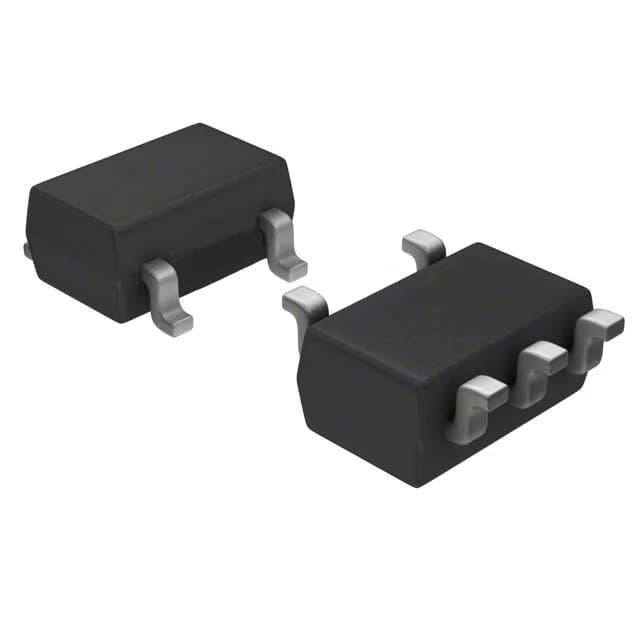
Housed in a SOT-23-5 (SC-74A) surface-mount package. The five-pin layout — single op amp with standard non-inverting, inverting, output, V+, and V- pins — fits a compact PCB area. No exposed thermal pad to worry about; the junction-to-ambient thermal path relies on the PCB copper. Keep the supply decoupling capacitor within a few millimetres of the V+ pin.
Lifecycle and sourcing posture
The MAX4281EUK+T carries an Active product status and is ROHS3 compliant. No end-of-life notification has been issued for this part.