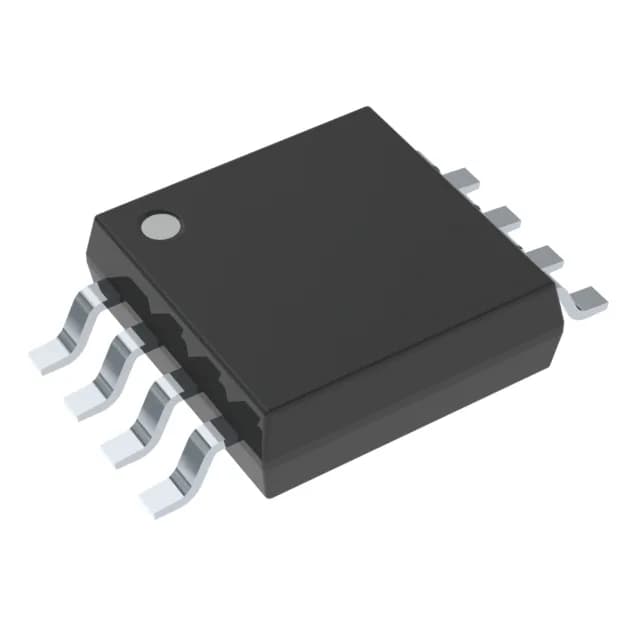
Dual op-amp for general-purpose signal chains
The Maxim Integrated MAX4252EUA+T is a dual-channel, general-purpose operational amplifier in an 8-uMAX/uSOP surface-mount package. It delivers a 3 MHz gain-bandwidth product and a 0.3 V/µs slew rate, with rail-to-rail push-pull output. Input offset voltage is 70 µV typical, and the CMOS input stage draws 0.1 pA bias current. Supply range spans 2.4 V to 5.5 V. Each amplifier consumes 420 µA supply current.
Rail-to-rail output and low offset for precision conditioning
The rail-to-rail output stage (push-pull, no dead zone) lets the amplifier swing within a few tens of millivolts of either supply rail, preserving dynamic range in low-voltage systems. Combined with the 70 µV input offset and 0.1 pA bias, the part handles precision DC amplification — weigh-scale bridges, thermocouple amplifiers, and current-sense front-ends — without external trimming. The 68 mA output current per channel can drive moderate loads like ADC inputs or small relays directly.
Industrial temperature range and supply flexibility
Rated for -40°C to 85°C operation, the MAX4252EUA+T fits outdoor telecom enclosures, factory-floor sensor modules, and under-hood-adjacent automotive electronics (non-AEC). The 2.4 V minimum supply allows operation from a single Li-ion cell through its discharge curve; the 5.5 V maximum covers 5 V ±10% rails. The 8-uMAX package (3 mm × 3 mm body) saves board area in multi-channel designs.
Slew rate and bandwidth — what they mean for your signal
The 3 MHz gain-bandwidth product supports small-signal gains up to a few hundred kHz — enough for audio-band filtering, motor-current sense loops, or ADC anti-aliasing. The 0.3 V/µs slew rate limits large-signal (full-swing) bandwidth to roughly 50 kHz; fast pulse amplifiers or high-frequency ADC drivers will hit slew-rate limiting before the GBW suggests. For those applications, a higher-slew-rate part (e.g., 10 V/µs or more) would be needed.
Active production — no LTB risk
The MAX4252EUA+T carries an Active product status with ROHS3 compliance.