3 MHz GBW, 0.3 V/µs slew — bandwidth ceiling for sensor conditioning
The MAX4251EUA+: In a unity-gain buffer, the small-signal bandwidth extends to 3 MHz, but the full-power bandwidth at 2 Vpp output is limited to roughly 15 kHz by the slew rate — enough for audio-frequency sensor signals, thermocouple amplifiers, and low-speed data-acquisition front-ends. The input common-mode range extends from the negative rail to within about 1 V of the positive rail, so the part accepts ground-referenced signals without a split supply.
420 µA supply, 1 pA bias — precision at low quiescent power
At 420 µA supply current (typical), the MAX4251EUA+ draws less than half a milliamp — competitive for battery-operated instrumentation where every 100 µA matters. The 1 pA input bias current (typical at 25°C) doubles roughly every 10°C, reaching about 16 pA at 85°C, still negligible for a 10 kΩ source impedance but worth derating for a 1 MΩ piezoelectric sensor.
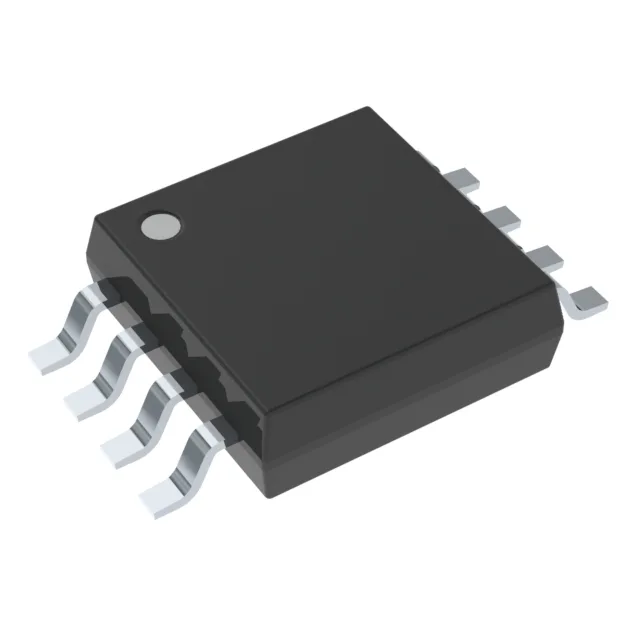
8-uMAX/uSOP — 3 mm-wide surface-mount footprint
Housed in an 8-lead MSOP (3.00 mm × 4.90 mm body, 0.65 mm pitch), the supplier device package is 8-uMAX/uSOP — the same mechanical outline as the MSOP-8. The 0.65 mm pitch is routable on a two-layer board with 0.2 mm trace/space rules; the exposed pad (if present on this variant) is not connected and can be tied to the negative rail or left floating.
Active, ROHS3 — no lifecycle risk for new designs
Analog Devices lists the MAX4251EUA+ as Active with ROHS3 compliance.