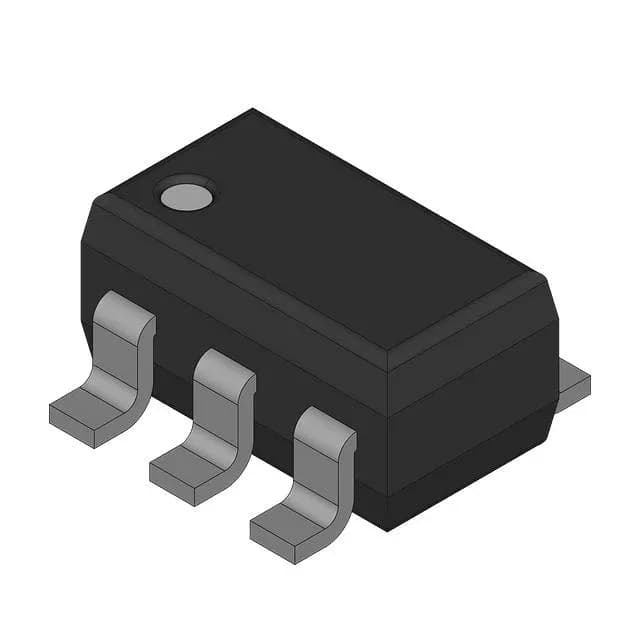
Design-in note for a single-supply signal chain
The MAX4250EUK.C60368: Key analog parameters include a 3 MHz gain-bandwidth product, a 0.3 V/µs slew rate, a 70 µV maximum input offset voltage, and a rail-to-rail push-pull output stage that swings within millivolts of both supply rails.
Signal-headroom and bandwidth budget
The 3 MHz gain-bandwidth product sets the practical small-signal bandwidth at a given closed-loop gain: at a gain of 10, expect roughly 300 kHz of usable bandwidth. The 0.3 V/µs slew rate limits full-power output swing to about 95 kHz at 2 V peak-to-peak, so this part suits audio-frequency filtering, sensor buffering, and general-purpose signal conditioning rather than high-speed video or fast transient amplification.
DC accuracy and input bias considerations
A 70 µV maximum input offset voltage lets the part handle precision tasks like thermocouple or strain-gauge amplification without external nulling. The 0.1 pA typical input bias current minimizes voltage error from source impedance.
Output drive and thermal margin
Each channel can source or sink 68 mA typical, enough to drive a 2 kΩ load to within 100 mV of the rails or to charge a small capacitive load. The SOT-23-5 package has a junction-to-ambient thermal resistance around 220°C/W; continuous operation at maximum ambient (85°C) and full output current should be checked against the power dissipation derating curve in the datasheet.