Low-bandwidth signal conditioning with a 90 kHz GBW
The MAX4241ESA+: These parametric limits mean the part is suited for DC and low-frequency AC signal conditioning — think thermocouple amplifiers, strain-gauge bridges, or photodiode current-to-voltage converters where the signal bandwidth stays under about 10 kHz. The 90 kHz GBW is the unity-gain crossover; at a closed-loop gain of 100, the usable bandwidth drops to roughly 900 Hz, so budget the noise-gain bandwidth product against the sensor's output spectrum.
Supply flexibility and output swing for single-rail designs
Output current is rated at 2.5 mA per channel — enough to drive a typical SAR ADC reference input or a low-impedance cable, but not a relay coil or a 50-ohm back-terminated line. Input bias current is 2 nA typical, and input offset voltage is 200 µV. For a 10 kΩ source impedance, the bias-current-induced offset is 20 µV — negligible in most precision loops, but at 1 MΩ source impedance that same bias current produces a 2 mV error, so high-impedance front-ends (pH probes, piezoelectric sensors) need a FET-input op-amp instead. Supply current is 14 µA, which keeps the part viable for always-on sensor nodes drawing tens of microamps from a coin cell.
Industrial temperature range and SOIC-8 footprint
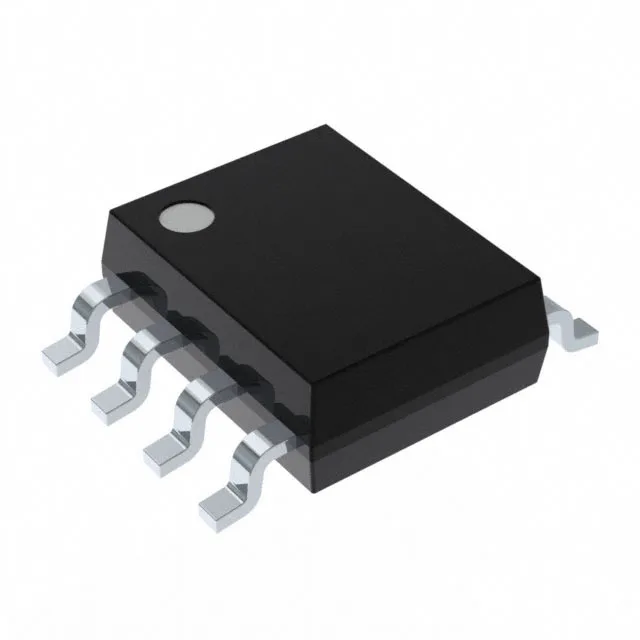
The part ships in an 8-pin SOIC package — a standard 0.154-inch-wide body with 1.27 mm pitch, compatible with the vast majority of SOIC-8 PCB footprints used across the industry. Mounting is surface-mount; the tube packaging is typical for prototype and low-volume assembly, though reel packaging exists for the same die in the MAX4241ESA+T variant if the pick-and-place line requires tape.