Signal-chain speed and drive for sensor front-ends
The MAX4233AUB+ pairs a 10 MHz gain-bandwidth product with a 10V/µs slew rate, making it suited for conditioning fast sensor signals — think photodiode transimpedance stages or high-speed ADC drivers where settling time matters. Each of the two CMOS amplifiers draws 1.2 mA supply current, a reasonable quiescent budget for a dual-channel active filter or multiplexed input stage in a battery-powered instrument. The rail-to-rail output stage delivers 200 mA per channel, enough to drive a moderate load directly — a small relay coil, an analog meter, or the input of a downstream ADC without a separate buffer.
Input precision and temperature range for industrial loops
Input bias current is 1 pA typical, a CMOS advantage that keeps the voltage error negligible when the source impedance is high — a 10 MΩ sensor sees only 10 µV of offset from bias current. Input offset voltage is 850 µV maximum, which sets the DC accuracy floor for the signal chain; for a gain-of-100 stage the output offset is 85 mV before any nulling.
Power supply flexibility and board integration
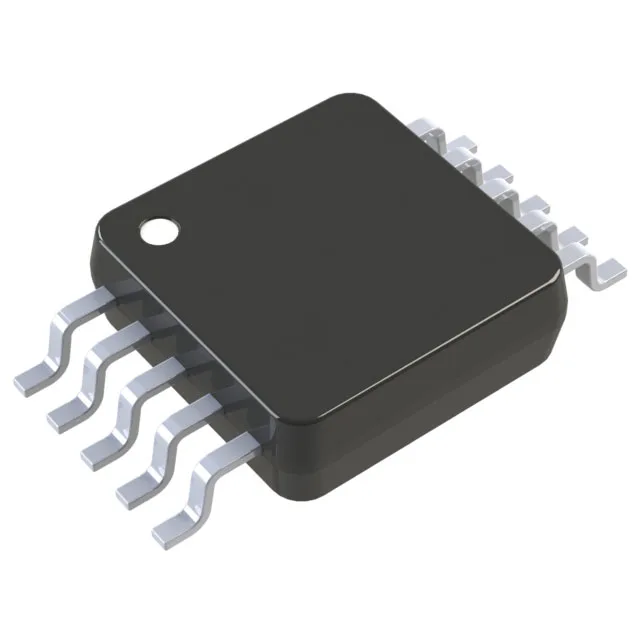
Housed in a 10-lead MSOP (also called uMAX/uSOP), the 3.00 mm × 3.00 mm body with 0.50 mm pitch fits tight mixed-signal layouts. The tube delivery suits low-to-medium volume builds where tape-and-reel is not required.
Lifecycle and compliance status
The part is ROHS3 compliant, meeting the current EU restriction level for lead, mercury, and other substances.