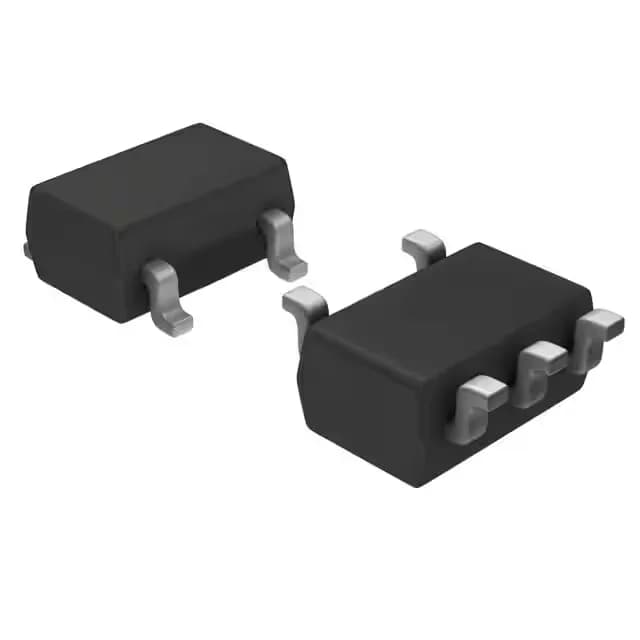
660 MHz buffer with 4200 V/µs slew rate in SOT-23-5
The supply span runs from 8 V minimum to 11 V maximum, drawing 2.2 mA quiescent current, and it delivers up to 90 mA per channel of output drive. Housed in a SOT-23-5 package (SC-74A, SOT-753), it fits tight PCB layouts where board area is at a premium.
The 4200 V/µs slew rate is the headline number that defines this part's application space. For a buffer, slew rate directly limits the maximum output voltage swing at a given frequency — a 1 V peak-to-peak signal at 660 MHz would demand roughly 4100 V/µs, so this part is sized for large-signal handling right up to its bandwidth corner. The 660 MHz -3dB bandwidth is the small-signal limit; in practice, the large-signal bandwidth will be lower and set by the slew rate. For video or pulsed signals with fast edges, the 4200 V/µs figure means the output can slew through a 2 V step in under 500 ps, which keeps edge rates clean for standards like 1080p or higher-resolution video paths.
The 8 V to 11 V supply span is relatively narrow compared to general-purpose op-amps, but it matches the common ±5 V or single 10 V rails used in high-speed analog front-ends. The 2.2 mA supply current is modest for a 660 MHz buffer — many competing parts in this speed class draw 5 mA or more. Output current capability of 90 mA per channel means it can drive 50 Ω or 75 Ω terminated lines directly, though the thermal limits of the SOT-23-5 package will constrain continuous drive into low-impedance loads. Input bias current is 800 nA and input offset voltage is 1 mV, both adequate for AC-coupled signal paths where DC accuracy is secondary to speed.
Package and temperature grade
The SOT-23-5 (SC-74A, SOT-753) footprint is a standard 5-pin surface-mount package with 0.95 mm pitch. Surface-mount assembly is straightforward with standard reflow profiles; the part is RoHS3 compliant per the listing.
Lifecycle and sourcing posture
There is no documented second-source or pin-compatible alternate from other manufacturers in the same SOT-23-5 footprint at this speed grade, so the BOM carries single-source risk for this exact buffer function.