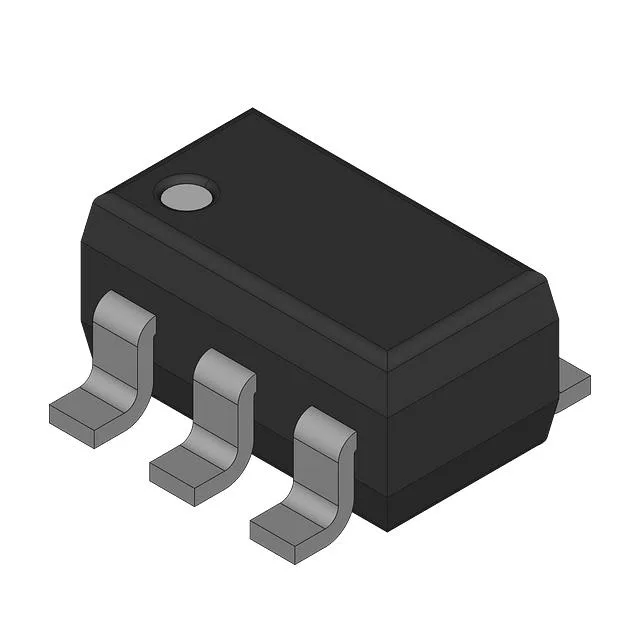
Active single-supply op-amp in SOT-23-5
The rail-to-rail output stage lets it swing close to the supply rails, useful when driving an ADC input without a separate reference.
The 2 MHz gain-bandwidth product sets the usable frequency range for a given closed-loop gain. At a gain of 10, expect a -3 dB bandwidth around 200 kHz, which covers most audio-band and low-frequency sensor conditioning. The 0.7 V/µs slew rate limits large-signal swing at higher frequencies — a 2 V peak-to-peak output slews fully in about 2.9 µs, so don't expect clean sine waves above roughly 110 kHz at full swing. For precision DC or low-frequency work like thermocouple or strain-gauge amplification, these numbers are more than adequate. The 230 kHz -3 dB bandwidth confirms the small-signal response for filtering applications.
The 355 µA supply current per channel is moderate — not the lowest for battery duty, but low enough for multi-channel boards where a dozen op-amps stay under 5 mA total. Input bias current is 50 pA typical, which keeps DC errors small when driving high-impedance sources like pH probes or photodiode transimpedance stages.
That means no LTB scramble or broker scavenger hunt for production builds.