That matters if you are qualifying it into a new design or restocking a production line — you are not sourcing against a sunset date.
A 10 MHz gain-bandwidth product with a 4V/µs slew rate puts this op-amp in the general-purpose fast-enough tier. It handles audio-band filtering, sensor conditioning up to a few hundred kHz, and moderate-speed ADC drive without struggling. The 4V/µs slew rate means a full 5 V step settles in about 1.25 µs — adequate for multiplexed data-acquisition front ends. If your design needs to swing rail-to-rail at higher frequencies, the slew rate becomes the limiter, not the GBW.
Single-supply operation with rail-to-rail output
The rail-to-rail output stage swings within millivolts of both rails, which is what you need when driving an ADC input or a single-supply comparator. Input common-mode range is not rail-to-rail on this device — it stops about 1.1 V below the positive rail — so high-side sensing at low supply voltages needs a different part. For most single-supply signal conditioning, though, it fits.
6-UCSP package — layout and assembly considerations
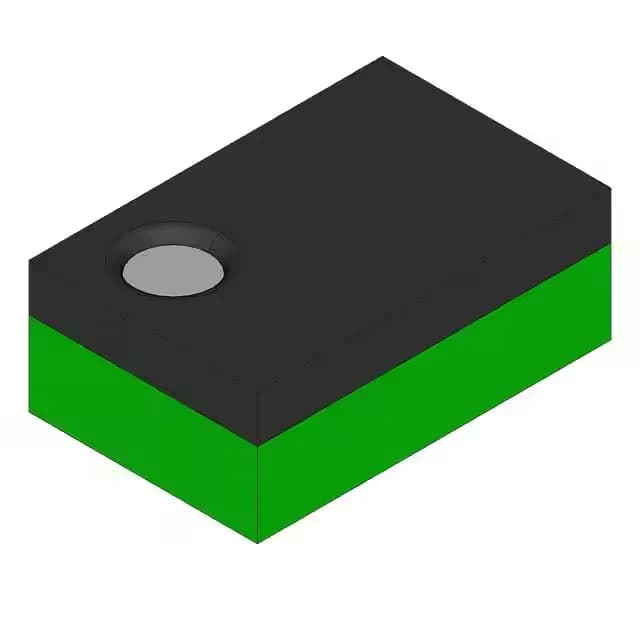
Housed in a 6-bump WFBGA/CSPBGA package (1.57 x 1.05 mm footprint), the MAX4131EBT+ is a true chip-scale device. That saves board area but demands careful PCB layout: the bumps are on a fine pitch, and solder-mask-defined pads are the norm. Reflow profile follows standard lead-free (ROHS3 compliant) parameters. No exposed thermal pad, so power dissipation is through the bumps and the PCB copper — keep the traces short and wide to the supply and output. If your assembly line is not set up for CSP, the same die is available in larger packages under different order codes.
Not rated for automotive under-hood (125°C) or downhole, but fine for the majority of industrial and commercial environments. The 1 mA supply current and 50 nA input bias stay stable across the range, though input offset voltage (350 µV max) may drift a few microvolts per degree — budget that if your system measures millivolt-level signals at temperature extremes.