What the 76 V supply span means for your rail
The MAX4080TAUA+T is a high-side current sense amplifier from Analog Devices, built to measure current on a supply rail that swings from 4.5 V up to 76 V. That 76 V ceiling covers 48 V telecom buses, 24 V industrial rails with headroom for transients, and 12 V automotive systems — all without an external regulator or level shifter on the sense input. It draws just 75 µA of supply current, so the measurement overhead on the rail is negligible — useful in battery-monitoring or always-on sense paths where every microamp counts.
Bandwidth, offset, and bias — the bench-level view
The 250 kHz -3 dB bandwidth sets the upper frequency for accurate current measurement. For a switching regulator running at a few hundred kHz, the output ripple current is captured; for a DC motor load, the bandwidth is more than enough to track the average current and the start-up surge. The offset contributes a DC error at the output that scales with the sense resistor value — a 10 mΩ shunt gives 10 mV/A, so 100 µV of offset translates to 10 mA of zero-current error. The 5 µA bias flows through the sense resistor and adds a small offset; for a 10 mΩ shunt that is 50 µV, negligible next to the offset term.
Package, temperature grade, and where it fits on the board
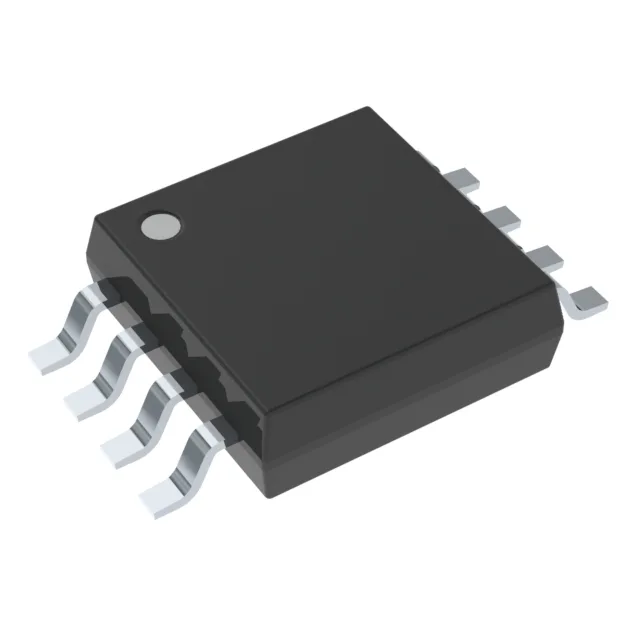
The part comes in an 8-uMAX/uSOP package, the same footprint as an 8-MSOP or 8-TSSOP — 3.00 mm wide, 0.118-inch pitch. Surface-mount only; the small body fits on a 2-layer board without trouble, and the exposed pad (if present on the variant) helps pull heat into the ground plane. The supply current stays at 75 µA across the range, though the offset voltage drifts with temperature — the datasheet's drift spec is the number to check for precision applications.