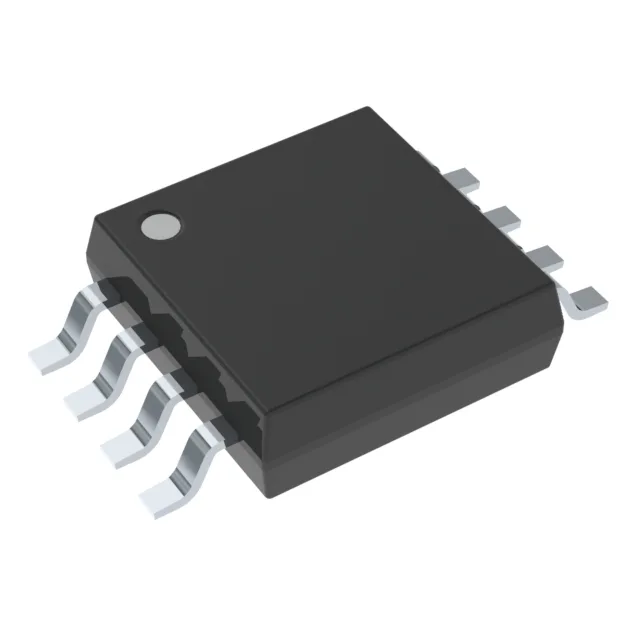
76 V common-mode, 75 µA quiescent — the current-sense amp for always-on monitoring
The MAX4080TAUA+ is a single-channel high-side current sense amplifier from Analog Devices, built to measure current into a load by sensing the voltage drop across a shunt resistor in the supply rail. Its 4.5 V to 76 V supply span covers everything from a 5 V logic rail up to a 48 V telecom bus or a 72 V industrial supply — no external level shifting needed on the input side. Quiescent current is 75 µA typical, which means this part can sit on a continuously powered rail in a battery-backed system without draining the reserve. The 250 kHz bandwidth is enough to capture load transients from a switching regulator or a motor drive step-change, but not so wide that it amplifies high-frequency switching noise into the ADC input without some filtering on the output.
Input offset and bias — what they mean for shunt selection
Input offset voltage is 100 µV maximum. Across a 10 mΩ shunt, that offset translates to a 10 mA zero-current error — acceptable for a 10 A full-scale measurement, but a larger shunt (say 50 mΩ) drops the error to 2 mA at the cost of dissipation. Input bias current is 5 µA, which flows through the shunt and adds a small systematic offset; it is stable over temperature and can be trimmed out in firmware. The amplifier is a single-supply design with a rail-to-rail output stage, so the output swing goes close to ground and Vcc without the dead zone typical of older current-sense amps. This matters when the ADC reference is 3.3 V and you need to resolve a 10 mV shunt drop at low load.
Temperature grade and package — fits industrial and automotive environments
The 8-MSOP package is 3 mm wide with a 0.65 mm pin pitch — small enough for a dense four-layer board, but the exposed pad is on the bottom of the uMAX package, so the thermal path goes through the PCB copper rather than a separate heatsink. The part is supplied in a tube and uses a surface-mount footprint. No special moisture sensitivity level is stated in the record, but the MSOP body is typical MSL-1 for this process — standard bake-out rules apply if the tube seal is broken and the parts sit in a humid environment before reflow.
Active lifecycle and compliance — no end-of-life risk for current designs
RoHS3 compliance is confirmed, covering the EU RoHS exemption list through the latest recast.