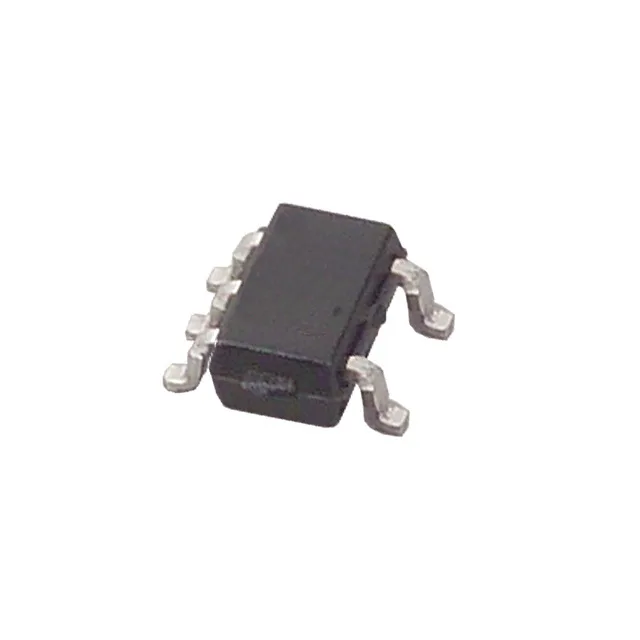
1.8 MHz current-sense amp in SC-70-5
The MAX4073TAXK+T is a single-channel current sense amplifier from Analog Devices, built to measure current on the high side of a supply rail. The 1.8 MHz -3dB bandwidth means it resolves fast load transients — useful for monitoring the current draw of a switching regulator output or a motor phase that changes load in microseconds.
Signal-chain fit and power budget
Quiescent supply current is 500 µA — low enough that the amplifier's own draw does not eat into the load budget on a battery-powered board, but not a nano-power part for always-on sensing. The 40 µA input bias current is the current that flows into the sense inputs; it adds a voltage drop across the external gain-setting resistors that must be accounted for in the measurement error budget. Input offset voltage is 1 mV. At the output, this offset appears multiplied by the gain of the external sense resistor and the amplifier's internal gain. For a 10 mΩ sense resistor carrying 1 A, the sense voltage is 10 mV — a 1 mV offset is a 10 % error at the low end of the range, so the resistor value and gain should be chosen to keep the sense voltage well above the offset floor.
Package and reflow reality
Housed in a 5-lead SC-70-5 (SOT-353), the MAX4073TAXK+T has a 0.65 mm lead pitch and a body that sits about 1.0 mm tall. The small footprint saves board space but the fine pitch means the solder paste stencil aperture needs to be sized correctly — a 0.4 mm square aperture per lead with a 0.125 mm stencil thickness is typical. No exposed pad, so the thermal path is through the leads only; the 500 µA supply current keeps self-heating negligible. MSL level is not explicitly stated in the record, but for a standard SC-70-5 package from Analog Devices, MSL-1 is typical — no bake required before reflow unless the bag has been opened for longer than the floor life. The tape-and-reel format feeds directly into a pick-and-place feeder; the SC-70-5 body is small enough that nozzle selection matters — a 0.7 mm or 0.8 mm ID nozzle with a flat tip holds it without tipping.
It lives in an engine bay ECU, a solar inverter enclosure, or a factory-floor sensor node without derating at the hot end.