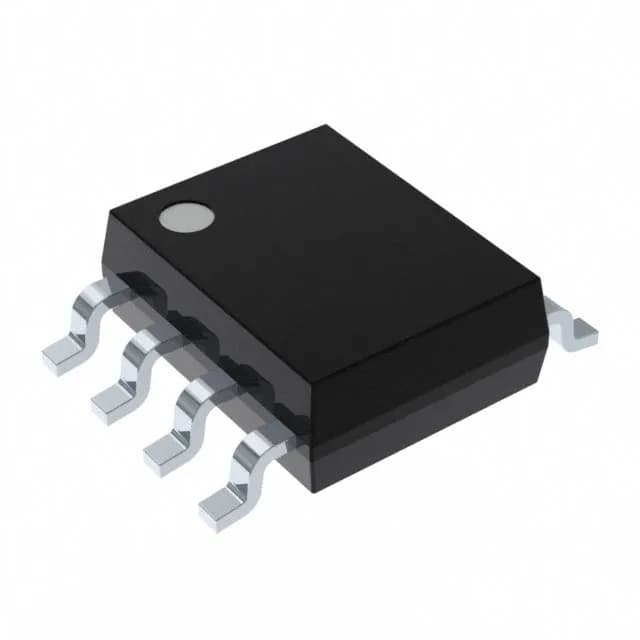
Micropower op-amp for battery-duty sensor conditioning
The Maxim MAX406BESA+ is a single-supply, general-purpose op-amp in an 8-SOIC package, built for applications where supply current is the binding constraint. Its 1 µA supply current and 8 kHz gain-bandwidth product place it squarely in the micropower, low-frequency class — think battery-powered thermistor or photodiode amplifiers, portable instrumentation, and always-on wake-up circuits that cannot afford a milliampere bias. The rail-to-rail output stage delivers the full supply swing, critical when running from a 2.5 V rail where every millivolt of headroom matters. Input offset voltage is 750 µV, and input bias current is a negligible 0.1 pA, so high-impedance sensor interfaces see minimal loading error.
0.005 V/µs slew rate — what it means for signal bandwidth
The 0.005 V/µs slew rate is the reality check on this part. For a 1 V peak-to-peak output swing, the full-power bandwidth works out to under 1 kHz. This is a DC-to-slow-AC amplifier, not a general-purpose audio or control-loop compensator. If your application needs to track a 10 kHz sine wave at any meaningful amplitude, this is not the part — look at the MAX4xx family's higher-speed siblings. But for filtering a 10 Hz temperature sensor output or buffering a DC reference, the slew limit is irrelevant and the micropower advantage is real.
Active lifecycle and sourcing posture
The MAX406BESA+ carries an Active lifecycle status from Maxim (now part of Analog Devices). No end-of-life notice or last-time-buy window has been issued. This is a current-production part, not a discontinued or NRND line, so it is suitable for new designs and ongoing production without an immediate obsolescence risk. The part is RoHS3 compliant.