Triple SPDT analog switch — 100Ω on-resistance, wide supply range
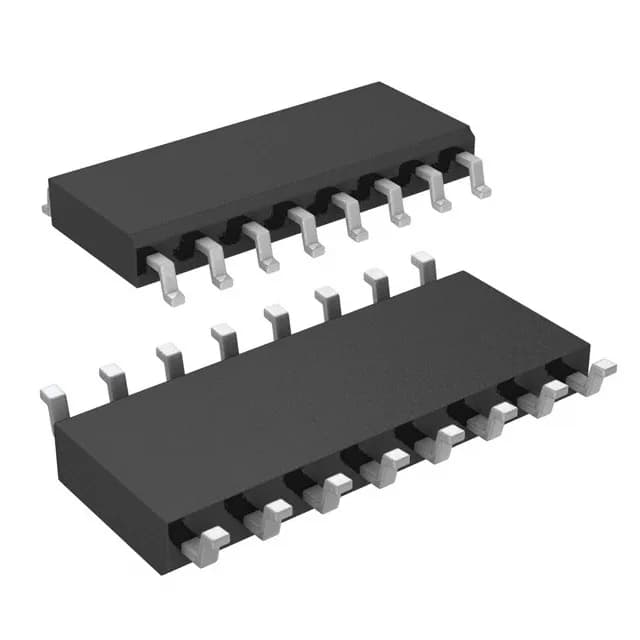
The Maxim Integrated MAX4053ESE+ is a triple single-pole double-throw (SPDT) analog switch in a 16-pin SOIC package. Each of the three independent switches routes a common input to one of two outputs (2:1 multiplexer/demultiplexer configuration). It operates from a single supply of 2V to 16V or dual supplies of ±2.7V to 8V, making it suitable for both battery-powered and industrial ±5V or ±3.3V systems. The on-resistance is 100Ω maximum, with channel-to-channel matching of 12Ω max, ensuring consistent signal attenuation across channels. Switching is fast — 175ns turn-on, 150ns turn-off — and crosstalk is rated at -90dB at 100kHz, preserving signal integrity in audio or low-frequency analog multiplexing. Charge injection is 2pC typical, minimizing glitch energy during channel changes.
Supply rails and temperature range — design-in flexibility
The wide single-supply range (2V to 16V) covers 3.3V, 5V, 12V, and 15V logic and analog rails without needing a separate regulator. Dual-supply operation (±2.7V to ±8V) allows bipolar signal switching, common in audio crosspoint matrices and data acquisition front-ends. The operating temperature range of -40°C to +85°C covers industrial and commercial environments — think motor drives, outdoor telecom, and factory automation panels where the ambient temperature can swing. The 16-SOIC package (3.90mm body width) is a standard footprint for board-level routing, with surface-mount assembly that suits automated pick-and-place lines.
Leakage and capacitance — what they mean for your signal path
Off-channel leakage current is 1nA maximum, which is low enough that it won't load down high-impedance sources like op-amp outputs or sensor buffers. Channel capacitance is 2pF for both source and drain pins (CS(off) and CD(off)), so the switch adds minimal capacitive loading to the signal path — important when switching high-frequency analog signals or when driving into a high-impedance ADC input. Together, these specs mean the MAX4053ESE+ can be used in precision analog multiplexing without introducing offset errors or bandwidth roll-off at audio frequencies.
Lifecycle and sourcing reality
It is ROHS3 compliant, so it meets the latest European hazardous-substance restrictions. For BOM planning, this part can be specified into new designs without worrying about near-term obsolescence. If you need a dual-sourcing option, the MAX4053 family includes other package variants (e.g., MAX4053CSE+ in SOIC, MAX4053EEE+ in QSOP) that are functionally identical but differ in package footprint; verify pin compatibility for your layout.